
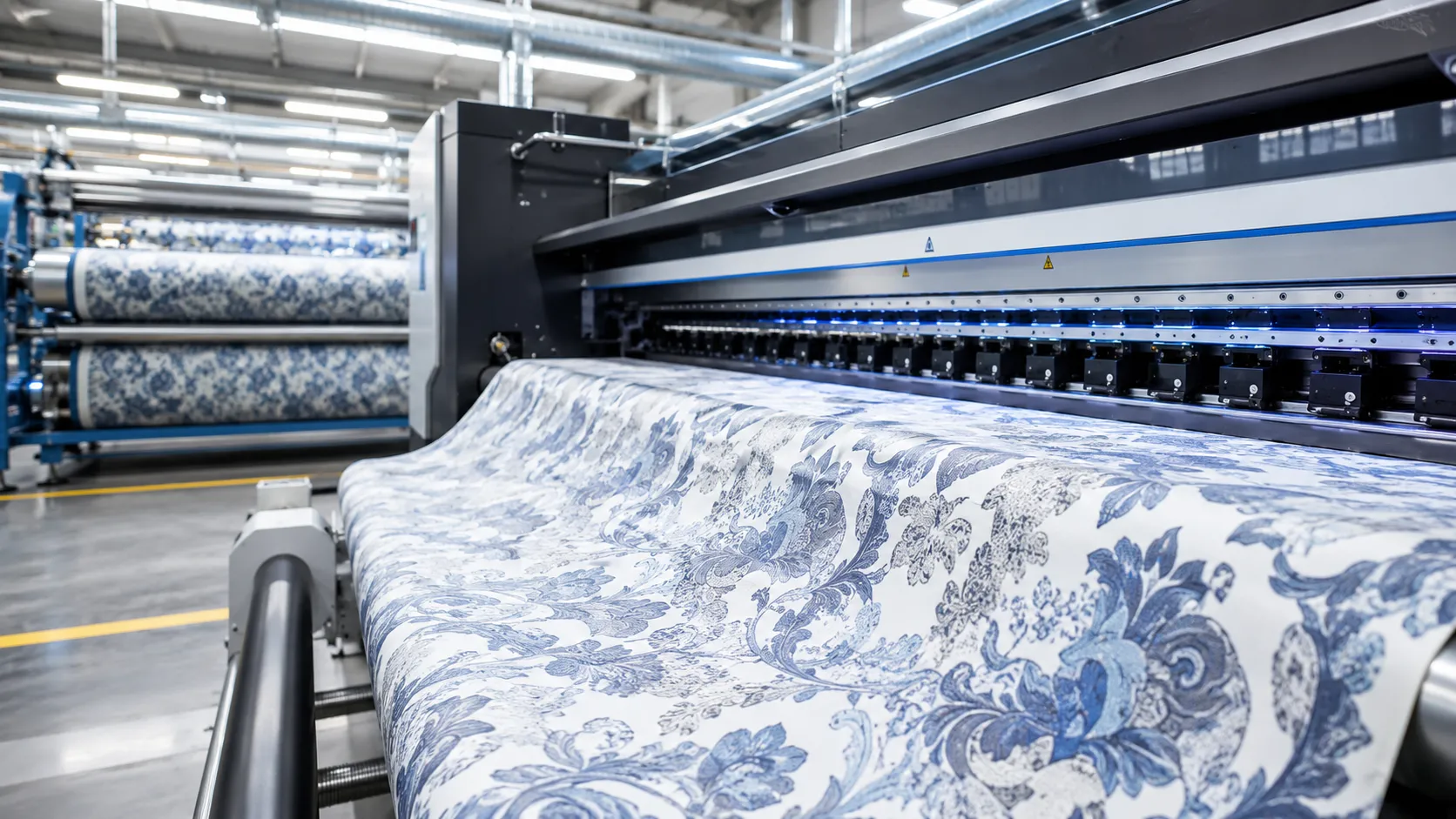
How do digital printing and rotary printing fundamentally differ?
The distinction between the two technologies begins with "how" the print is transferred. In rotary printing, the print paste is pressed onto the fabric from inside rotating cylindrical screens (rotary screen). Each colour requires a separate cylinder; if a design contains 6 colours, 6 screens are set up on the machine. This setup (engraving/screen preparation, paste recipe, machine adjustment) is a one-off preparatory investment and is independent of yardage. Once it is set up, the machine can print tens of metres per minute, so over long runs this fixed cost is spread across a large number of metres and the unit print cost falls rapidly.
In digital printing there is no screen. The design is transferred directly from a digital file onto the fabric; common approaches on knitted fabric are direct-to-fabric printing (DTG-like reactive/pigment digital) and transfer printing. Setup is almost zero: preparing the file and calibrating the colour profile is enough. By contrast, every metre carries a relatively fixed cost in terms of ink and machine time; whether you print 50 metres or 5,000 metres, the cost per metre stays roughly the same. This structural difference explains why the cost curves of the two methods cross.
Digital and rotary are two complementary options on our facility's knitting, dyeing and printing line; the right method is chosen according to the complexity of the design and the order profile. For the general framework of printing processes, see our dyeing and printing guide.
Which method has the lower cost: digital or rotary?
Thinking of cost as a single "price per metre" is misleading. The cost of every print job is the sum of two components: a one-off fixed cost (setup) and a variable cost that rises with yardage (ink/paste, machine time, labour). In rotary printing the fixed cost is high and the variable cost is low. In digital printing the fixed cost is low, while the variable cost is high relative to rotary and relatively fixed against yardage.
This structure creates a classic break-even logic. At small numbers of metres, rotary's heavy setup cost becomes a very large burden per unit; digital is cheaper by a wide margin. As yardage increases, rotary's setup cost is increasingly spread across more metres and, at a certain point, the total cost of the two methods becomes equal. Beyond this break-even point, rotary becomes cheaper. Exactly where the break-even point falls varies from job to job depending on the number of colours, fabric type, design area and current ink/paste costs, so let us clarify the concrete figure specifically for your project.
| Criterion | Digital printing (DTG / transfer) | Rotary printing (rotary screen) |
|---|---|---|
| Setup cost | Very low (screen-free, from file) | High (a separate cylinder/screen for each colour) |
| Unit cost curve | Relatively fixed against yardage | Falls rapidly as yardage increases |
| Effect of number of colours on cost | Number of colours barely changes the cost | Each additional colour = additional screen = additional setup cost |
| At low yardage | Economical | Expensive (setup spread across few metres) |
| At high yardage | Relatively expensive | Economical (setup spread across many metres) |
| Design-change flexibility | High (no new setup) | Low (each design needs a new screen) |
The summary of the table is this: the cost advantage between digital and rotary shifts according to yardage. For this reason the question of "which is cheaper" cannot be answered without being tied to the questions of "how many metres, how many colours and how many repeats".
Which method is strained by number of colours, detail and gradients?
The visual structure of the design often determines the method before cost does. Because rotary printing prints each colour with a separate screen, it is excellent for patterns containing a limited number of flat colours: the colours are solid, saturated and extremely consistent throughout the repeat. However, as the number of colours increases, both the setup cost and the technical difficulty grow. Soft transitions (gradients) and photographic images are either very difficult in rotary with a finite number of screens, or require a quality compromise.
This is precisely where digital printing excels. Because there is no screen logic, the number of colours in the design barely changes the cost in practice; ten colours or a hundred colours are processed in the same print run. Fine detail, small text, photographs and gradients are achieved naturally in digital. By contrast, for printing a solid, highly saturated single colour over very large areas, rotary's paste transfer can still be advantageous. When assessing the consistency of colours between shipments and the approval process, our colour fastness and ΔE<1 criteria come into play; lab-dip and approval discipline apply to both methods.
| Design feature | Digital printing | Rotary printing |
|---|---|---|
| Multi-colour / photographic | Ideal, no extra cost | Difficult, many screens required |
| Soft gradient / transition | Achieved naturally | Limited, may involve a quality compromise |
| Fine detail / small text | High resolution | Limited by screen fineness |
| Few flat/solid colours | Possible, limited advantage | Ideal, colours saturated and consistent |
| Large-area solid colour | Ink density increases | Strong, full coverage with paste |
| Repeating pattern (repeat) | Possible | Very suitable by the nature of the cylinder |
In practice, the choice of method is clarified at the intersection of cost and visual structure: low-colour, high-yardage repeat orders point to rotary, while multi-colour, detailed or low-yardage work points to digital.
How do MOQ and order flexibility change between the two methods?
MOQ (minimum order quantity) is in fact the commercial face of break-even logic. Because a cylinder and setup cost arise for each design in rotary printing, a certain yardage must be exceeded to bring this cost down to a reasonable unit price. For this reason rotary is, by nature, suited to higher yardages and repeating orders; in very small batches the unit cost becomes commercially indefensible.
Digital printing largely removes this constraint. Because the setup cost is low, the difference in unit cost between a single metre and hundreds of metres is relatively small; this makes scenarios such as low MOQ, rapid sampling, collection variation and in-season reprints economical. Changing the design is a matter of a new file, not a new screen. This flexibility becomes decisive in product development and fast-fashion cycles. Because concrete MOQ and lead-time values change according to fabric, pattern and capacity, let us clarify these on a project basis.
| Order scenario | Recommended direction | Rationale |
|---|---|---|
| Sample / capsule collection | Digital | Low MOQ, no setup cost |
| Small batches with many variations | Digital | Each variant does not require a new screen |
| Rapid in-season reprint | Digital | Fast repeat from file, flexible |
| High-yardage single design | Rotary | Setup spread across many metres, unit cost falls |
| Repeating volume production | Rotary | Screen made once, used many times |
| Low-colour high volume | Rotary | Low unit cost + solid colour |
In short, digital starts with flexibility and a low barrier to entry; rotary takes over the unit-cost advantage as volume grows. It is more accurate to see the two methods not as competitors, but as a spectrum of choice according to the order profile.
Which questions should you ask to choose the right method?
Instead of leaving the choice of method to intuition, addressing it with a few structured questions gives the soundest result in terms of both cost and quality. The first is yardage: total volume including repeats shows which side of the break-even logic you stand on. The second is the number of colours and design structure: many colours, gradients and detail point to digital; a small number of solid colours points to rotary. The third is the likelihood of repeat: if the design will be printed many times over, rotary's setup cost turns into an investment.
The fourth is the need for flexibility: if rapid sampling, in-season variation and low MOQ are required, digital is the natural choice. These four axes often conflict with one another; for example, high yardage points to rotary, but a multi-colour photographic design points to digital. In such conflicts the decision is made jointly by fabric type, end use, fastness expectations and commercial priorities. Because we knit in-house and manage pretreatment, dyeing and printing through our vetted contract network under one point of contact, we can optimise the choice of method together with the entire supply chain; you can find the advantages of this coordinated approach on our coordinated contract network page.
To make the decision matrix practical, we can summarise the choice of method by combining two axes:
| Yardage \ Design | Low-colour, solid | Multi-colour, detailed/gradient |
|---|---|---|
| Low yardage | Digital (to avoid setup) | Digital (suitable in every respect) |
| Medium yardage | Break-even zone; assessed on a job basis | Generally digital |
| High yardage | Rotary (lowest unit cost) | Depends on the case; gradients strain rotary |
This matrix is a starting framework; the real decision is made together with your design, your target cost and your shipment plan. Colour consistency, fastness and approval discipline are carried out with the same rigour in both methods.
Frequently asked questions
How does digital printing fundamentally differ from rotary screen printing?
Rotary screen printing is an analogue method in which a separate engraved cylinder screen is prepared for each colour; the print paste is forced from the rotating cylinder onto the fabric. Set-up cost is high, but the running speed per metre is high. Digital printing, by contrast, is screenless and prints directly from the file (DTG-like reactive/pigment or transfer). Set-up is virtually zero, and unit cost stays relatively flat regardless of length run.
For a short-run order, is digital or rotary more economical?
At low yardage, digital is far cheaper. Rotary's high set-up cost (screen/cylinder engraving, paste recipe, machine make-ready) is divided over few metres, so it becomes a heavy burden per unit. As yardage grows, that fixed cost is spread over more metres, and beyond the break-even point rotary becomes cheaper. Thinking in terms of a single 'price per metre' is misleading.
In which method does the number of colours in a design drive up cost?
In rotary, every additional colour means a separate screen, that is, an extra set-up cost; a 6-colour design requires 6 screens to be mounted on the machine. In digital there is no screen logic, so the number of colours barely affects cost in practice; ten colours and a hundred colours are processed in the same print run. That is why multi-colour work is the natural domain of digital.
Which method suits gradient and photographic designs?
Multi-colour, photographic or soft-gradient designs are the natural domain of digital printing; fine detail, small type and smooth transitions are achieved naturally in digital. In rotary, gradients and photographic imagery with a finite number of screens are either very difficult or require a quality compromise. By contrast, for solid, highly saturated single colours over large areas, rotary's paste lay-down remains advantageous.
Where does the MOQ (minimum order quantity) difference between the two methods come from?
MOQ is the commercial face of break-even logic. Because rotary incurs a cylinder and set-up cost for every design, a certain yardage must be exceeded to reach a reasonable unit price; on very small lots the unit cost is indefensible. Digital largely removes this constraint: thanks to low set-up, low MOQ, fast sampling, collection variants and in-season reprints all become economical.
Which questions should we answer to choose the right print method?
Four questions are decisive: how many metres will be printed (volume, including repeats), how many colours are in the design, will the design repeat, and is gradient/detail required. High yardage and few solid colours point to rotary; many colours, gradients, detail and a need for low MOQ point to digital. When the axes conflict, fabric type, end use, fastness expectations and commercial priorities together determine the decision.