
What exactly is finishing, and how does it differ from dyeing?
The life of a knitted fabric does not end on the machine. Greige fabric, coming off the tube or open-width, is in a tense and unbalanced state; the tension loaded onto the loops during knitting has not yet been released. Finishing covers the entire chain that turns this fabric into a usable product: pretreatment (washing, bleaching, making hydrophilic), dyeing/printing and, at the very end, the finishing stage. This stage is the "behaviour engineering" part of the chain.
Dyeing gives the fabric its colour; finishing determines how the fabric will behave. Two fabrics can be made from the same yarn, the same knit structure and the same colour, but if one shrinks a size in the first wash while the other stays stable, the difference is almost always in the finishing. That is why, for the buyer, finishing parameters — sanforized or compacted, which heat-set temperature — are as concrete a technical specification as colour.
It helps to divide the finishing steps into four functional groups: thermal setting (stenter, heat-set), mechanical pre-shrinking (sanforizing, compacting), chemical surface/handle treatments (softening, finish) and special functional finishes (water repellency, wicking, antimicrobial). We take each of these in turn below.
What is sanforizing and how does it control the shrinkage rate?
The fundamental cause of shrinkage in knitted fabric is the tension "lent" to the loops during knitting. When the fabric is washed and heated, the fibres and loops relax, the tension is released and the fabric shortens. Sanforizing carries out this shortening before the consumer, in a controlled manner. The fabric is moistened, softened with steam and pushed back lengthwise by being compressed between an elastic felt/blanket and a feed cylinder. At the exit the fabric has effectively shortened in length and the loop geometry has relaxed.
The practical result: an untreated single jersey may shrink markedly in the first wash, whereas in a correctly sanforized fabric the wash shrinkage falls into a narrow band. The critical point here is that there is no such thing as "zero shrinkage" — the goal is to bring shrinkage within the tolerance range (in the length/width direction) prescribed by the standards. This tolerance varies according to the end-product type and the brand's test protocol; let us clarify it together.
Another benefit of sanforizing is managing the balance between length and width shrinkage. Not only the length but also the width is balanced through the adjusted feed; this reduces complaints of "bagging" or distortion after laundering (together with spirality).
How does compacting (compact finishing) set the width and weight?
Whereas sanforizing mostly foregrounds length shrinkage, compacting focuses on controlling the width and the weight associated with it. On the compacting machine the fabric is compressed in the width direction under moisture and heat; the loops move closer together, the amount of yarn per unit area increases and the weight rises. This is the principal way to hit the "such-and-such width, such-and-such weight" target the buyer specifies.
Compact finishing also gives the fabric a more "set" (settled, balanced) feel; the surface is smoother and the handle fuller. In single jersey, interlock and rib-type fabrics, the compact version is generally regarded as safer in terms of dimensional stability after laundering.
| Property | Sanforizing (pre-shrinking) | Compacting |
|---|---|---|
| Primary purpose | Take up length shrinkage in advance | Bring width + weight to target |
| Main axis of effect | Length direction (warp/wale) | Width direction (course) |
| Effect on handle | Relaxed, tension released | Fuller, more "set" |
| Effect on weight | Slight increase | Marked/controlled increase |
| Typical use | General knits, shrinkage-critical product | Product with tight width/weight tolerance |
In practice the two often complement one another: first thermal setting and width adjustment, then mechanical pre-shrinking. Which combination is correct depends on the fabric structure and the test targets of the end product.
What do the stenter and heat-set do?
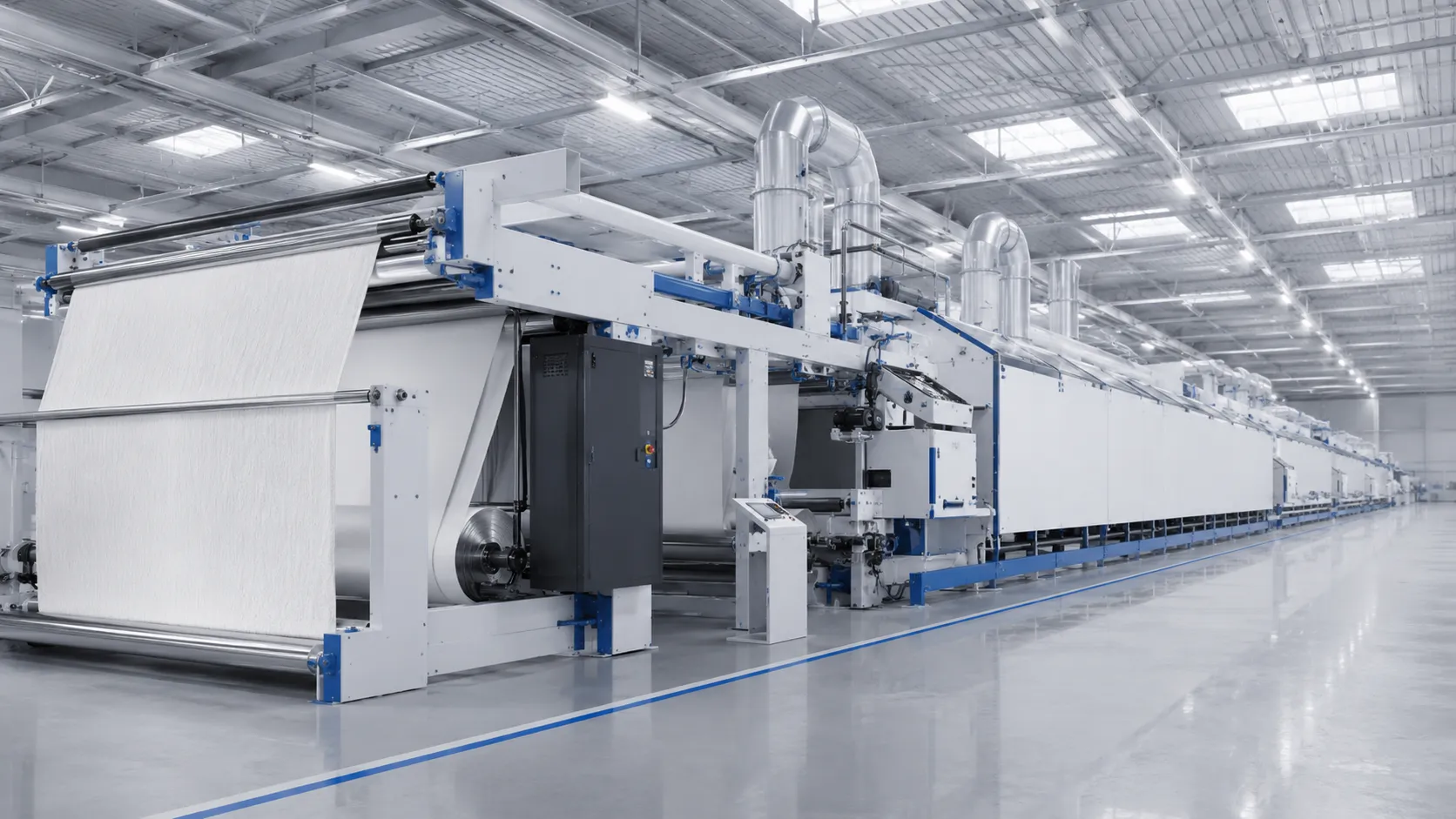
The stenter is the backbone of finishing. The fabric is gripped on both sides by pinned/clipped chains, stretched to the desired width and dried by passing through a hot-air tunnel. Three things happen here at once: the fabric is brought to the target width, dried and — especially in fabrics containing polyester, nylon and elastane/Lycra — thermally set.
Heat-set exploits the thermoplastic nature of synthetic fibres. When a fibre is heated above its glass transition temperature and then cooled, it "remembers" its new geometry. This improves dimensional stability and recovery in elastane-containing fabrics, as well as surface smoothness in cotton/polyester blends. The heat-set temperature and dwell time are chosen carefully according to the fibre type; the wrong temperature either leaves the setting incomplete or hardens the hand and creates a risk of yellowing.
The stenter is also the principal platform for applying softener, hydrophilic, water-repellent or wicking finishes to the fabric and drying them — the fabric that passes through the finish bath is dried on the stenter and the finish is fixed onto the fibre surface.
| Finishing step | Function | Effect on the fabric |
|---|---|---|
| Stenter | Width adjustment, drying, finish fixation | Target width, smooth surface, finish adhesion |
| Heat-set (thermal setting) | Thermal setting of the synthetic fibre | Permanent dimensional stability, spirality resistance |
| Sanforizing | Mechanical length pre-shrinking | Low wash shrinkage, relaxed loops |
| Compacting | Width/weight compression | Target weight, full handle, low residual shrinkage |
| Softening / finish | Handle and functional chemistry | Soft hand, water repellency, wicking, etc. |
How do softening and finishing change the handle?
Two fabrics can hit the same shrinkage and weight values, but if one feels "like paper" and the other "silky", the difference is in the finish chemistry. Softeners (silicone-based, fatty-acid derivative, etc.) coat the fibre surface, lowering friction and giving the fabric flow/drape. Silicones generally give a bulky, slippery hand, while hydrophilic softeners preserve moisture absorption and are therefore preferred especially in underwear.
The choice of finish is always a balancing act: excessive softening can reduce wicking performance, and a water-repellent finish can harden the handle. For this reason handle, like colour, should be fixed against an approval sample (hand standard) and production should be checked against this reference. For functional finishes, the relevant fastness and performance tests (e.g. durability after washing) are written into the product specification.
How does finishing affect dimensional stability and spirality?
Spirality is a torque fault that shows itself in single-ply fabrics such as single jersey as a sideways drift of the seam lines; its origin lies in yarn twist imbalance and knit geometry. Although finishing cannot eliminate it entirely, it can bring it to an acceptable level with heat-set and balanced stretching. Even and symmetrical feed, thermal setting and correct width adjustment suppress spirality.
Dimensional stability, in turn, is the joint product of sanforizing, compacting and heat-set. None of these steps is sufficient on its own; the correct sequence and parameter combination is decisive. We have a separate guide that treats this subject in depth, with its cause/measurement/test dimension: it is recommended that it be considered together with the dyeing-printing and finishing guide.
The practical takeaway for the buyer: fix a fabric not only by colour and weight but also by its finishing recipe. If parameters such as "sanforized/compact", "heat-set", "softener type" do not appear in the specification, the risk of inconsistency between suppliers and batch-to-batch deviation increases.
How should the finishing recipe be fixed in the specification?
A good finishing specification reduces surprises in production. As a minimum it should include: fabric structure and yarn; target width (tube/open width) and weight; pre-shrinking method; whether heat-set will be carried out; the finishes to be applied and the functional expectations; the accepted dimensional stability tolerances and the applicable test standard.
The golden rule here is to determine the numerical targets together with the supplier according to the product and test protocol. There is no single "correct" shrinkage percentage; underwear, outerwear and home textiles work in different bands. For this reason, rather than a concrete commitment, agreeing on a pre-production approved sample and a written tolerance is the soundest path.
| Specification item | Why it matters | How it is fixed |
|---|---|---|
| Pre-shrinking type | Determines wash shrinkage | Sanforized / compact choice is written down |
| Heat-set status | Stability + spirality resistance | Yes/no and parameter suited to fibre type |
| Target width / weight | Cutting efficiency and handle | Measured against the approval sample |
| Shrinkage tolerance | Risk of consumer complaints | Standard + tolerance band is defined |
| Finish / handle | Feel and function | Hand standard is signed off |
Because KARCEM knits in-house and coordinates dyeing and finishing through a vetted contract network under a single point of contact, feedback between these parameters is fast: if a finishing step spoils the shrinkage or the handle, the recipe is corrected without losing the thread of the chain. We describe the advantage of this coordinated model on the colour and process control side separately on the coordinated contract network advantage page.
Frequently asked questions
What is the difference between sanforizing and compacting, and when should I ask for which?
Both perform mechanical pre-shrinkage, but their emphasis differs. Sanforizing removes lengthwise shrinkage in advance; it compresses the fabric in the wet-elastic state along the length direction, relaxes the loop geometry and releases tension, with a mild effect on weight. Compacting, by contrast, sets the width and the associated weight to target; it draws the loops closer in the width direction, gives a fuller and more set hand, and increases the weight in a marked, controlled way. Sanforizing comes to the fore for products where shrinkage is critical, compacting where the width/weight tolerance is tight; most often they complement each other.
Does sanforizing reduce wash shrinkage to zero?
No; there is no such thing as zero shrinkage. Sanforizing takes up, in a controlled way before the consumer, the length the fabric would already shrink in washing, so that wash shrinkage falls within a narrow tolerance band. The aim is to bring shrinkage within the tolerance range (in the length/width direction) prescribed by the standards. This tolerance varies according to the end-product type and the brand's test protocol; underwear, outerwear and home textiles work in different bands. The correct percentage must be clarified together with the supplier, according to the product and test protocol.
Why does heat-setting come to the fore only in synthetic and elastane-containing fabrics?
Because heat-setting exploits the thermoplastic nature of synthetic fibers. A fiber containing polyester, nylon or elastane/Lycra, when heated above the glass transition temperature and then cooled, remembers its new geometry. This improves dimensional stability and recovery in elastane-containing fabrics, and surface smoothness in cotton/polyester blends, while making spirality resistance permanent. Heat-setting temperature and time are selected carefully according to fiber type; the wrong temperature either leaves the setting incomplete or stiffens the hand and creates a risk of yellowing.
Two fabrics hold the same shrinkage and weight, but one feels like paper and the other silky; where does the difference come from?
The difference lies in the finishing chemistry. Softening is a chemical finish that gives lubricity to the fiber surface and determines the hand the fabric is felt to have. Softeners (silicone-based, fatty-acid derivatives) coat the fiber surface, lower friction and impart drape. Silicones give a voluminous, slippery hand, while hydrophilic softeners are preferred in underwear because they preserve moisture absorption. Finishing is a matter of balance: excessive softening can reduce wicking. Like color, the hand must be locked down against an approval sample (hand standard).
Can spirality (torque) be completely eliminated by finishing?
It cannot be completely eliminated. Spirality is a torque defect that appears in single-jersey-type fabrics as the seam lines slide sideways; its origin lies in yarn twist imbalance and knit geometry. Although finishing cannot eliminate it, heat-setting and balanced stretching can bring it to an acceptable level. Even and symmetrical feeding, heat-setting and correct width adjustment suppress spirality. Dimensional stability, too, is the joint product of sanforizing, compacting and heat-setting; a single step is not enough, the correct sequence and parameter combination is decisive.
How should I lock down the finishing parameters in the specification?
Write the finishing parameters as clearly as the color. At a minimum, the following should be present: fabric construction and yarn; target width (tubular/open width) and weight; pre-shrinkage type (sanforizing/compacting); whether heat-setting will be done and the parameters appropriate to the fiber type; the finishes to be applied and the functional expectations; the accepted dimensional stability tolerances and the applicable test standard. If these items are not written down, the risk of inconsistency between suppliers and batch-to-batch deviation increases. The approval sample must be signed off so that it references color, hand and dimensional behavior alike.