
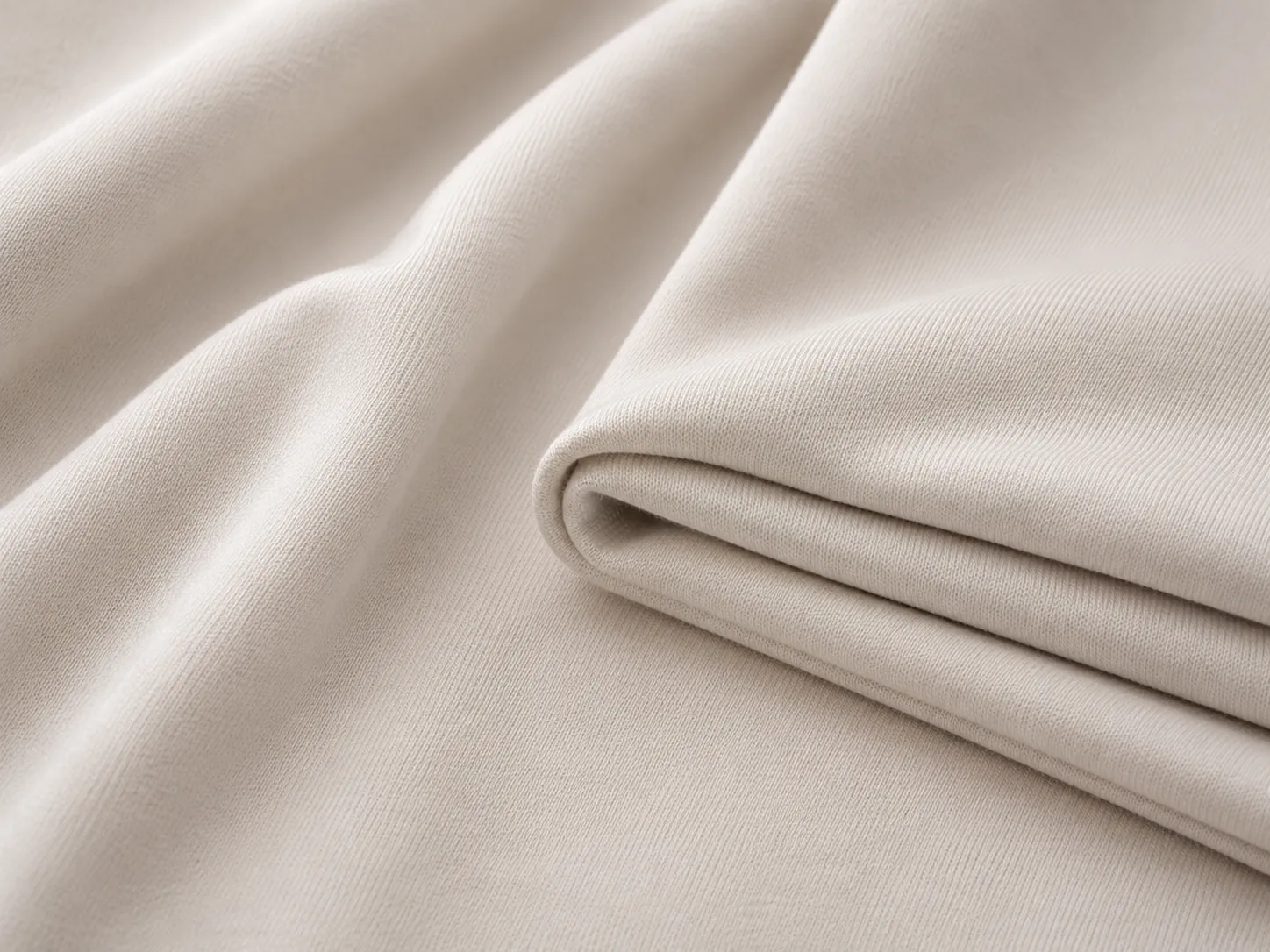
Interlock is a knitted fabric produced with a double-knit technique in which two separate needle beds work interlocked with one another, showing flat loops on both faces. By its very structure it is firmer, fuller and dimensionally more stable than single-faced knits such as single jersey. KARCEM produces interlock in the knitting department at its Esenyurt facility, offering it in weights and a hand suited to garment-manufacturing needs.
What is interlock fabric and how is it structured?
Interlock takes its name from the way the two needle beds on the knitting machine "interlock" their loops with one another. It is regarded as an advanced derivative of classic rib (1×1 rib) knitting: the 1×1 face-and-back sequence visible in rib knit is hidden in interlock by two separate loop layers overlapping one another. As a result, both the front and back faces of the fabric look flat and are indistinguishable from each other.
This double-layered construction gives the fabric a balance not found in single-faced knits. While the edges of single-faced knitted fabrics curl inward by nature, interlock's symmetrical structure eliminates this curling. Because this property makes cutting and sewing easier in garment production, it makes interlock a preferred base, especially for collared and detailed products.
The difference between interlock and single jersey
Although both fabrics are mostly knitted from cotton yarn, their structural construction is fundamentally different. Single jersey is a single-faced fabric knitted on a single needle bed; its front face is flat, its back face shows the loop rows, and its edges curl. Interlock, on the other hand, is a thicker and more stable fabric with both faces flat thanks to its double-bed structure.
| Property | Interlock | Single jersey |
|---|---|---|
| Knit type | Double knit (two needle beds) | Single knit (single needle bed) |
| Face appearance | Both faces flat and identical | Front flat, back loopy |
| Edge curling | Does not curl | Curls |
| Hand | Firm, full | Thin, fluid |
| Opacity | High | Medium |
| Typical weight | 180-260 g/m² | 120-200 g/m² |
Which fabric is right depends on the requirements of the product. For a fluid, lightweight t-shirt, single jersey stands out; for a more structured and durable product, interlock comes to the fore. For a detailed comparison of the two fabrics, you can refer to the single jersey vs interlock comparison.
The main properties of interlock
Interlock's popularity in garment manufacturing stems from several distinct technical advantages:
- Dimensional stability: The double-layered structure increases the fabric's tendency to hold its shape during washing and use; with the right finishing, shrinkage rates are kept under control.
- Opacity: The two loop layers make the fabric more opaque, which reduces transparency problems in light colors and thin garments.
- Firm, full hand: The fabric feels heavier and more substantial in the hand; this is valuable for products seeking a premium perception.
- Durability: The double-knit construction makes the fabric more resistant to abrasion and repeated washing.
- No curling: The edges staying flat improves sewing quality and product finish.
These properties make interlock a fabric that is plain in appearance yet structurally strong. When stretch is required, an addition of Lycra (elastane) can be added to the structure to produce interlock-lycra variants.
Interlock weight and selection
The typical weight range of interlock is between 180-260 g/m². Because of its double-layered structure, this range starts heavier than single jersey fabrics intended for similar uses. Weight selection is made according to the product's season and the desired hand: the lower end of the range for lightweight babywear, and the upper end for substantial products such as sweatsuits and dresses.
Weight is not only about heaviness; it is also a critical parameter that determines the balance of coverage, durability and cost. To select the right weight, the weight (GSM) guide is a useful reference.
Applications of interlock
Interlock has a wide range of uses in both everyday wear and quality garment products. Thanks to its stable and opaque structure, it is frequently preferred in the following products:
- Polo shirts: The collar standing upright and the fabric not curling make interlock ideal for polos.
- Premium t-shirts: Its firm hand and opacity add value in upper-segment t-shirts.
- Baby and children's wear: Its soft, opaque and durable structure is suitable for baby products.
- Dresses and skirts: Its structure that holds form without sagging provides the drape sought in plain-cut dresses.
- Sweatsuits and casual wear: Because of its durability and body, it is used in sweatshirt tops and bottoms.
Interlock fabric care
Interlock is a fabric that holds its form for a long time with the right care. The general recommendation, while following the instructions on the product label, is to wash cotton interlock at around 30 °C, inside out and with similar colors. The use of softener should be kept moderate; excessive softener can weaken the fabric's moisture-absorbing property.
Low heat should be preferred for drying, and high-temperature machine drying should be avoided, because heat increases the risk of shrinkage in cotton knits. Interlock generally does not require ironing and can be ironed at medium heat when needed. The finishing processes applied during production largely determine the fabric's dimensional behavior.
Interlock fabric we manufacture — composition and GSM
As a interlock fabric manufacturer and supplier in Turkey, KARCEM knits greige fabric on its own circular machines and coordinates dyeing, printing and finishing across an audited contract network. Typical constructions and weight ranges we produce:
| Composition | Weight (g/m²) | Width | Typical use |
|---|---|---|---|
| 100% combed cotton interlock | 180–240 | Tubular | Premium tees, polos, dresses |
| Cotton / elastane interlock | 200–260 | Tubular | Fitted dresses and tops |
| Polyester / recycled PES interlock | 160–220 | Open width | Sportswear, sublimation print |
| CVC / poly-cotton interlock | 190–240 | Tubular | Workwear and uniform tops |
Capacity, MOQ and lead time
Our knitting capacity is around 450 tonnes per month, so we serve both low-MOQ development runs and high-volume repeat programmes. MOQ is not a single figure — it is defined per colour, weight and process together, so a realistic minimum becomes clear once we see your combination. Lead time depends on quantity, finish and dye-lot planning and is confirmed with your quote. See our MOQ, sampling and lead-time and lab-dip approval pages, then request a interlock fabric quote with your composition, GSM and quantity.
Certifications and compliance
We work with GOTS, OCS, GRS and RCS certified processes and BCI cotton. Colour is targeted at ΔE<1 versus the approved lab dip, with fastness and dimensional-stability testing available on request. See our certificates and colour-fastness pages for detail.
OEM, private-label and export
KARCEM supplies interlock fabric as an OEM and private-label knit fabric manufacturer: greige-to-finished production under your specification, ready for your own cut-and-sew or garment supplier. We export knit fabric from Turkey to the EU, UK, Middle East, North America and Russia on EXW, FOB or CIF terms. For programme pricing per kilogram, share your annual volume and target constructions.
Frequently asked questions
What is the minimum order quantity (MOQ) for interlock fabric?
MOQ is flexible and set per colour and construction. We accommodate development lots and high-volume repeat orders; share your composition, GSM and quantity and we confirm the exact minimum with the quote.
Do you export interlock fabric to Europe?
Yes. We export interlock and other knit fabrics from Turkey to the EU, UK, Middle East, North America and Russia, on EXW, FOB or CIF terms with the certificates your market requires.
Why choose interlock over single jersey?
Interlock is a double-knit: both faces are identical and flat, it does not curl at the edges and it feels firmer and more stable — ideal for premium tees, polos and dresses where structure and dimensional stability matter.
Do you offer organic or recycled interlock?
Yes. We can produce interlock in GOTS/OCS organic cotton and GRS/RCS recycled polyester, supplied with valid transaction certificates.
Are interlok and interlock the same thing?
Yes. The word "interlok" is the Turkish spelling of the English term "interlock"; both describe the same double-knit fabric. Both spellings are used in the industry.
Does interlock fabric curl?
No. One of interlock's most distinct advantages is that its edges do not curl. This property stems from its symmetrical double-layered structure and makes it easy to handle during cutting and sewing.
Which is thicker, interlock or single jersey?
Interlock is thicker. Because of its double-knit structure, interlock fabrics intended for the same purpose start at a higher weight than single jersey and feel firmer and fuller in the hand.
Does interlock stretch?
Interlock offers natural stretch across the width, but it does not have elasticity as high as rib knit. When more stretch is required, elastane (Lycra) is added to the knit.
Which season is interlock suitable for?
Depending on the weight selection, interlock can be used in all four seasons. Low-weight interlock is preferred in spring-summer products, while high-weight interlock is preferred in autumn-winter products.
With KARCEM
In interlock production, consistent weight, stable dimensions and color reliability are the real value that working with a knitted fabric manufacturer brings. KARCEM controls the process end to end, from raw knit to finished lot.
One contact, end to end: knitting on our own machines · dyeing, printing and finishing at supervised contract partners · lot quality control · ΔE<1 colour verification · certificates and TCs · sampling · shipment. See the production process →
Products made with this fabric: Underwear & Baby Clothing Fabric
Certification and documents: Certifications · How to Verify a Textile Certificate