
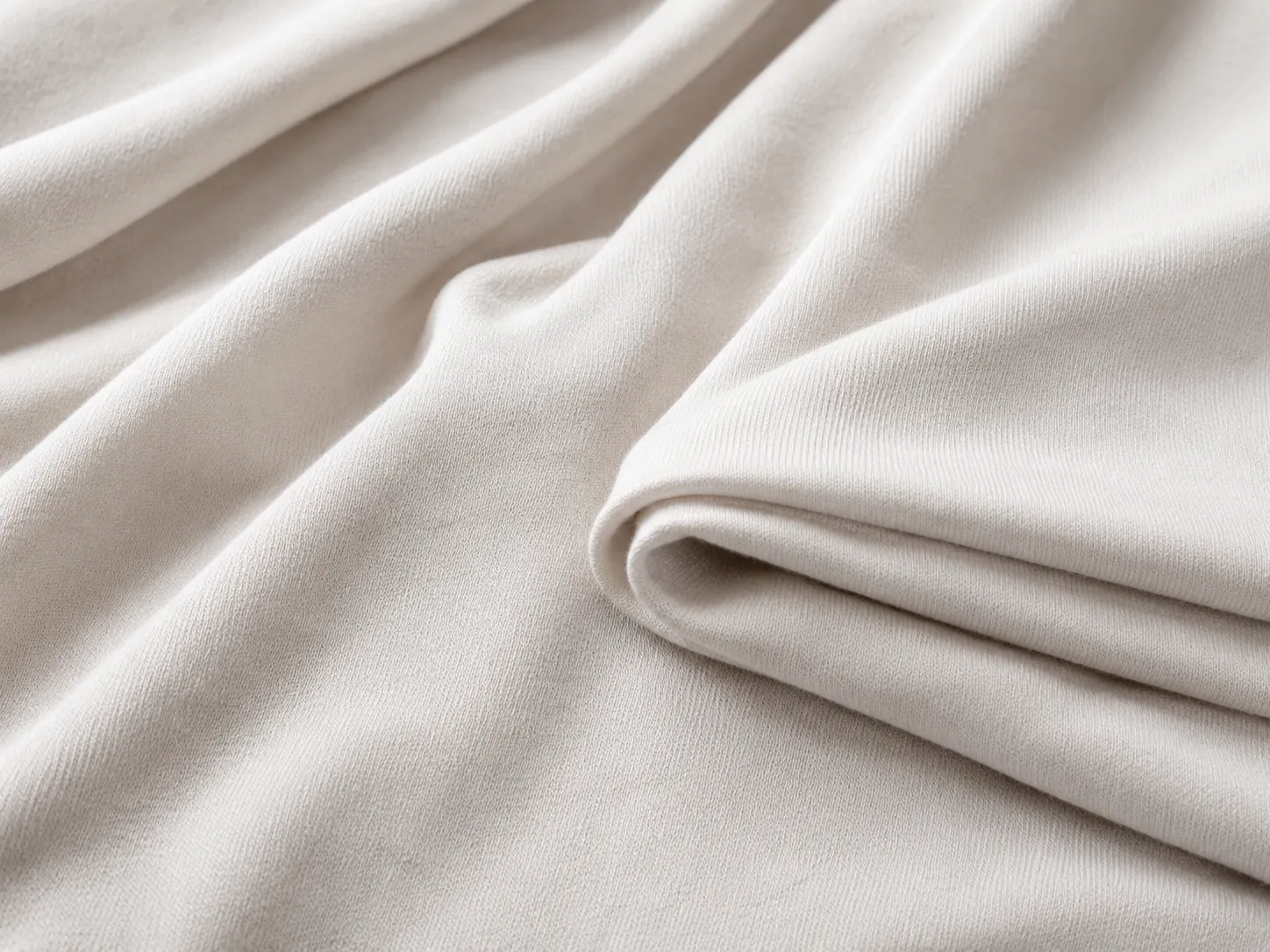
The structural difference: single bed vs. double bed
The character of every knit fabric begins with the needle arrangement on the knitting machine. Single jersey (süprem) is knitted on a single needle bed: every loop faces one direction, so one side of the fabric appears smooth (the loop face) and the other appears reverse (the purl side). This is the simplest, lightest knit structure and the most widely produced knit fabric family in the world.
Interlock, on the other hand, is knitted on a double needle bed, with two opposing rows of needles working together. In practice it is like two rib(1x1) fabrics joined back to back: both faces carry the same smooth loop appearance. This double-layered structure makes interlock both fuller and more stable in behaviour than single jersey. Interlock is technically a specialised derivative of rib; whereas in rib the wales sit separately front and back, in interlock the loops lock directly opposite one another, and this interlocking gives the fabric its symmetry.
This structural difference affects not only appearance but also production speed and cost. A single-bed single jersey machine knits faster and produces more metres from the same amount of yarn; a double-bed interlock, running two needle systems for every course, is a slower and more yarn-intensive process. So the structure decision is, before drape, also a decision about budget and lead time.
Typical weight ranges and measurement
Even when knitted from the same yarn, interlock carries more yarn per square metre because of its double-layered structure; it therefore typically sits at a higher weight (GSM) than an equivalent single jersey. As a general industry norm:
- Single jersey: typically 120-180 g/m². The ideal range for fine, summer T-shirts and underwear.
- Interlock: typically 180-260 g/m². Firmer and more opaque; the choice for premium T-shirts and babywear.
These ranges shift according to yarn count (Ne), knit density and the finishing process; the net target weight should always be discussed in terms of the finished (after-treatment) value. Greige fabric coming off the loom shrinks widthwise after washing and compacting and gains weight; specifying a final target such as "160 g/m² finished" is therefore far safer than agreeing on a greige value.
Weight measurement is a standardised test: a sample of fixed area (usually 100 cm²) is cut from the fabric with a GSM cutter, weighed on a precision balance in a conditioned environment and converted to a per-square-metre value. In industry this measurement is carried out to ISO 3801 or ASTM D3776; both standards define a publicly available method for measuring mass per unit area. The weight tolerance is typically agreed at around ±5%.
Which has better drape and firm handle?
Single jersey is light and fluid; it gives a soft drape that follows the body. This makes it right for dynamic, flowing silhouettes and lightweight summer pieces. Interlock, by contrast, has body: being thicker and fuller, the fabric "carries itself" and offers a more structured, upright handle. Its matt, smooth surface reinforces a premium perception; in printing too it provides a flatter, cleaner ground.
Weight alone does not determine drape; the yarn type is at least as influential. A single jersey knitted from combed cotton drapes softer and more lustrous than a carded single jersey of the same weight. Viscose or modal blends increase fluidity, while cotton-dominant interlock stands more upright. So when you say "I want drape", you need to discuss both the structure and the yarn choice together.
Dimensional stability and edge curl
This is the most practical difference separating the two fabrics in the sewing room. Because of its single-layered structure, single jersey curls at the edges when cut (inward at the sides, outward at the top and bottom). This requires extra care during spreading, cutting and sewing, and sometimes an auxiliary process. Interlock, thanks to its symmetric double-layered structure, does not curl; it lies flat, and its cutting and sewing are more predictable.
In dimensional stability too, interlock is generally ahead: its balanced structure is more resistant to shrinkage and distortion in the wash. Single jersey, like both fabrics, is stabilised with correct sanforizing/compact finishing and a controlled shrinkage test, but with its inherent character interlock starts out more stable.
Single jersey, owing to its one-directional loop structure, also tends to show spirality (skew/twist): seam lines can shift sideways after washing. Interlock's balanced structure eliminates this tendency in practice. Publicly available test standards are used to control spirality and shrinkage: the washing procedure is run to ISO 6330, dimensional change measurement to ISO 5077 (or AATCC 135) and spirality measurement to ISO 16322. These tests are the publicly available methods for verifying that the shrinkage percentage declared at sample approval is also achieved in production.
Opacity, printing and dye suitability
Interlock's double-layer structure creates a fuller, light-blocking ground; for this reason interlock in the same colour appears more opaque than single jersey. If a white or light-toned piece is expected "not to show through", interlock or a higher-weight single jersey is the right choice. Fine single jersey (for example 130 g/m² white) carries a transparency risk in light colours.
In printing, interlock's flat, matt surface provides a clean base for transfer and screen printing; fine details sit more crisply. Printing works smoothly on single jersey too, but edge curl can require extra securing on the spreading and printing table. In dyeing, both fabrics, when cotton-dominant, are an excellent match for reactive dyeing; high colour fastness and deep tones are achieved. Colour consistency can be controlled on both fabrics with a target of ΔE<1.
Side-by-side comparison
| Property | Single jersey (süprem) | Interlock |
|---|---|---|
| Structure | Single bed, single-layered; two faces differ | Double bed, double-layered; both faces same and smooth |
| Typical weight | 120-180 g/m² | 180-260 g/m² |
| Drape | Light, fluid, body-following | Firm, full, structured and upright |
| Dimensional stability | Good (stabilised by finishing) | Very good; balanced structure |
| Edge curl | Curls | Does not curl |
| Spirality tendency | Present (one-directional loop) | Practically none (symmetric) |
| Opacity | Transparency risk at low weight | High; double-layer ground |
| Cost (structure-driven) | Less yarn, lower | More yarn, higher |
| Typical product | T-shirt, underwear, lightweight summer | Premium T-shirt, baby/childrenswear, polo body |
Where does the cost difference come from?
Because fabric is mostly priced by the kilogram, every difference in weight feeds directly into cost. Interlock's double-layered structure means more yarn mass per metre; in addition, the slower knitting of the double-bed machine lowers production efficiency. When these two factors combine, interlock comes out consistently more expensive than an equivalent single jersey. If lightness and cost are the priority, single jersey is the sensible choice; if premium handle and durability are the priority, interlock is. The cost decision should be evaluated not on structure alone but together with the yarn type (combed/carded/compact); because combed yarn pushes the price up independently of weight.
End-use examples
Where single jersey shines: classic summer T-shirts, underwear, lightweight crew-neck, fluid women's tops, lining. If cost and lightness are the priority, single jersey is the right starting point. Single jersey with Lycra (elastane) added, which hugs the body and holds its form, is also common.
Where interlock shines: thicker and premium T-shirts, baby and childrenswear (an advantage being that both faces touching the skin are smooth and soft), pieces where both faces remain visible, clean-ground print work. When elastane is added, it gives a form-retaining, quality handle. It is also used as the body fabric in structured pieces such as piqué and polo.
Frequently asked questions
How can single jersey edge curl be prevented?
Curling is the natural result of single-layer loop tension; this is why interlock does not curl while single jersey does. The way to deal with it in production is not to ignore the fabric but to design it into the process: good compacting in finishing reduces tension, relaxing the fabric before cutting releases internal tension, and overlock and coverstitch seams in sewing fix the edge. On very fine pieces where curling is hard to manage, switching to interlock is also a valid solution.
At which weight is opacity achieved?
Transparency risk is most visible in white and light pastel tones; dark colours are perceived as more opaque at the same weight. While a fine 130 g/m² white single jersey may let light through, a 190 g/m² interlock in the same colour stays safely opaque. If opacity is critical, the right approach is either to raise the weight or to switch to interlock; the final decision should always be seen on a dyed finished sample, in real light.
Which should I choose for which product?
The decision depends on the product's promise. For light, fluid, cost-sensitive products such as summer basic T-shirts, undershirts and lining, single jersey is the natural choice. Interlock comes to the fore in premium T-shirts, baby/childrenswear, pieces with both faces visible and clean-ground print work. There is no "good/bad" between the two fabrics; there is only suitability for the handle and end-use that the collection demands.
When which one? Decision guide
- If you want lightness and drape → single jersey. Body-following, summer, fluid pieces.
- If you want firm handle and premium perception → interlock. Structured, full, upright silhouettes.
- If both faces are visible or touch the skin → interlock. Both faces being smooth and even is decisive.
- If cost and lightness are your priority → single jersey. Less yarn, lower weight.
- If opacity is critical → interlock or a higher-weight single jersey.
- If you want to minimise the curling problem in sewing → interlock lies flat; if you have chosen single jersey, plan the finishing and cutting process accordingly.
There is no "good/bad" between single jersey and interlock; there is only suitability for the handle, weight and end-use that the collection demands. For a broader view you can review the knit fabric guide, read the weight (GSM) guide to deepen your weight selection, and filter the entire portfolio by type, composition and weight from the Fabrics page.