
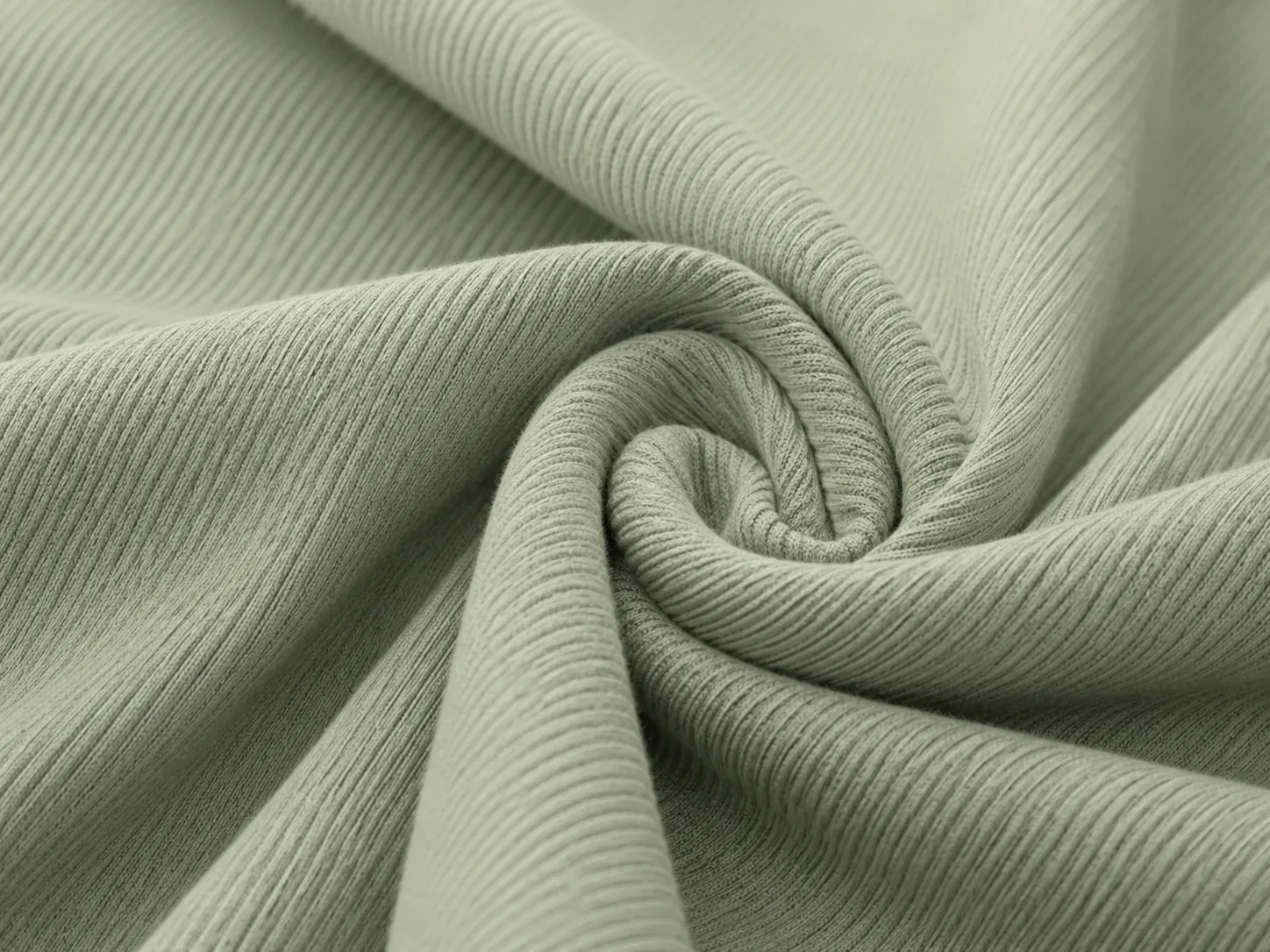
When it comes to cuffs, collars and waistbands in apparel, two fabrics come to mind: 1x1 rib and 2x2 rib. Both belong to the rib (wale) knit family and are known for their widthways stretch. The difference is not decorative but structural: the arrangement of the needles. This arrangement determines how much the fabric stretches, how much it recovers after stretching, and what kind of fullness it gives in the hand. To put a design decision on a solid footing, you first need to understand this structure. Chosen correctly, rib trim is an invisible piece of engineering that keeps a t-shirt's collar line standing for years; chosen wrongly, it turns into a defect that sags and ripples at the first wash.
Structural basis: 1x1 rib and 2x2 rib
Rib(1x1) is the structure known in textile language as 1x1 rib. During knitting, one face loop and one reverse loop are arranged in turn; that is, a single face wale alternates with a single reverse wale. The result is that both faces of the fabric look the same, and vertical, fine wales appear. This symmetry is the signature of the rib structure: unlike a single-plate knit such as single jersey, the fabric does not curl at the edge and lies flat.
2x2 rib, on the other hand, has a 2x2 rib structure. Here two face loops are arranged consecutively, then two reverse loops consecutively. The wales are therefore grouped more widely and more distinctly. Although they come from the same rib family, this simple difference in arrangement changes the entire physical behaviour of the fabric. In practice, the widening of the wale "groove" spacing causes the structure to travel a greater distance as it opens widthways and to form a more pronounced relief on the surface.
Both structures are knitted on a double needle bed (cylinder + dial); in this respect 1x1 rib and 2x2 rib sit between single jersey, knitted on a single plate, and interlock, the other relative of the double plate. Interlock is two ribs interlaced and locked together, and it does not stretch; 1x1 rib and 2x2 rib, by contrast, retain the "open" rib structure and so give high widthways stretch. Once you grasp this basic distinction, all of the behavioural differences below read as outcomes deriving from a single root — wale width.
What does the wale structure do on the surface?
The appearance of the wale is not merely aesthetic; it is also a herald of how the fabric will behave. The fine wale of 1x1 rib carries the yarn to the surface in shorter "journeys"; the result is a springier, tighter response to stretching. The wide wale groups of 2x2 rib hold a greater share of yarn at the surface; this explains both the visible texture and the full handle. Even when knitted from the same yarn at the same density, because of the difference in wale width 2x2 rib feels "fuller" in the hand, while 1x1 rib reads as more "flat and settled". This is why 1x1 rib comes to the fore where a brand wants to finish a collar-and-cuff detail without drawing attention, and 2x2 rib where it wants to add a decorative texture.
Widthways stretch and recovery
Both fabrics give high stretch in the width direction (widthways); this is the nature of the rib structure. The reverse loops between the wales open and release when the fabric is stretched, and gather back when released. The nuance between them is this:
- 1x1 rib, having denser and finer wales, gives a springier, tighter response to widthways stretch. It stretches and gathers up quickly within a narrow range; this is why it is preferred for fine, settled cuff and collar trims.
- 2x2 rib, with its wide wale groups, opens over a wider range. Its stretch allowance is comparatively more generous and the structure leaves a softer feel under tension.
Recovery (returning to its former shape after stretching) depends in both fabrics on yarn quality and knit tightness. Pure cotton rib may give a little over time under repeated stretching; permanent recovery is generally secured by adding elastane to the structure (see below). There is an important distinction here: instant stretch (how far the fabric opens) is the work of the rib structure; permanent recovery (returning to the original shape after hundreds of washes) is largely the work of the elastane and the correct setting/heat-set process. Confusing the two concepts is the most common source of the "it stretches but doesn't come back" complaint.
Handle: the firm and full difference
The clearest difference felt in the hand is in the touch. The fine wales of 1x1 rib give a flatter, more disciplined surface; a fine and settled handle. The wide wales of 2x2 rib, on the other hand, create a more pronounced raised effect on the surface; they leave a firmer, fuller, voluminous feel. Even at the same weight, 2x2 rib is generally perceived as "fuller", because the wale groups create more relief on the surface. This relief also affects the fabric's play of light and shadow: the 2x2 rib surface does not give a print ground as smooth as a flat-knitted single jersey, but when used as a body fabric it offers a decorative texture in its own right.
Where to use which: cuff, collar, waistband and body
The structural differences translate directly into the area of use:
- Cuff and sleeve opening: if a fine, closely fitting, quick-recovering trim is wanted, 1x1 rib is the standard choice. With single jersey and interlock bodies it gives a clean, narrow finish; it is expected to sit at the wrist and stay there without loosening.
- Collar: 1x1 rib dominates in crew and polo collars; the fine wale holds a neat, crisp line at the collar edge. Because the collar is the most stretched and most looked-at area on the garment, elastane content is most often mandatory here.
- Waistband and drawstring: in places where a wider, fuller trim is needed, such as the waistbands of joggers, cardigans and jackets, the firm structure of 2x2 rib comes to the fore. The wide wale provides both volume and handle in a wide waistband.
- Body fabric: 2x2 rib is not only an accessory; it is also used as the main fabric in products that fit the body and are expected to stretch, such as bodysuits, slim-fit blouses, base layers and socks. Its wide-wale appearance adds a decorative texture. 1x1 rib is also frequently used in ribbed bodysuit and base-layer bodies; the fine wale gives a more delicate, body-hugging look.
The most practical difference between cuff/collar and body is the width of the fabric and the way it is knitted. Cuffs and collars are mostly knitted as a narrow tube or band, while body 2x2 rib is produced as a wide tube or open width. Same composition, same structure; different width and different cutting logic. This is why, when "2x2 rib cuff + 2x2 rib body" are wanted together in a collection, the two are planned separately as different rolls.
The effect of adding elastane
Pure cotton 1x1 rib and 2x2 rib stretch; but what really secures permanent recovery is the elastane yarn added to the structure. An elastane content generally in the range of 3-8% gives the fabric a marked "snap back": when a stretched area is released it returns to its original shape much faster and more completely. This prevents, especially in close-fitting products, the sagging of the knee/elbow area and the loosening of the cuff over time. In 1x1 rib, elastane provides fit without disturbing the fine structure; in 2x2 rib, it adds continuity to the full handle.
In elastane rib fabrics, the critical point is the heat treatment during finishing. Setting the elastane under tension by heat-set (thermal fixation) determines the fabric's dimensional stability; an elastane rib that is not correctly set shrinks or ripples more than expected in the wash. To address the subject of dimensional stability more broadly, you can review the dimensional stability and spirality guide; in rib trims, shrinkage behaviour is assessed with the same tests as the body fabric but with different acceptance criteria.
Comparison of 1x1 rib and 2x2 rib
| Property | 1x1 rib | 2x2 rib |
|---|---|---|
| Knit structure | 1x1 rib | 2x2 rib |
| Wale appearance | Fine, dense | Wide, distinctly grouped |
| Handle | Fine, settled, disciplined | Firm, full, voluminous |
| Widthways stretch | High, springy/tight response | High, more generous opening |
| Typical use | Cuff, collar, sleeve opening | Waistband, drawstring, body fabric |
| Typical weight range* | Generally 180-280 g/m² | Generally 180-300 g/m² |
| With elastane | Permanent fit in a fine structure | Permanent recovery in a full handle |
*Weight values vary according to yarn count, composition and knit tightness; the above are approximate industry-norm ranges.
How do you choose which property? Decision parameters
The choice is less about looking for a single "better fabric" than about matching the most suitable structure to the product's demand. The following parameters are the questions that should be asked in turn when preparing a specification:
| Decision parameter | Points to 1x1 rib | Points to 2x2 rib |
|---|---|---|
| Product area | Cuff, collar, sleeve opening | Waistband, drawstring, body fabric |
| Desired handle | Fine, settled, unobtrusive | Firm, full, decorative texture |
| Stretch character | Springy, tight over a narrow range | Generous, soft opening |
| Visible texture requirement | Flat, minimal | Pronounced wide wale |
| High-tension area | Collar edge, narrow cuff | Wide waistband |
| Elastane requirement | For fit without disturbing the fine structure | For permanent recovery in a wide structure |
In practice, many t-shirts use a 1x1 rib collar and cuff together with a single jersey body; in the sweat group, 2x2 rib waistband and sleeve openings pair with a two/three-thread body. So the question is most often not "1x1 rib or 2x2 rib" but "which one for this area".
Testing and acceptance: what is checked in rib trim?
The performance of rib trim is verified in the laboratory not by eye but by public standard methods. For dimensional stability, the sample is first washed under standard conditions (wash procedure per ISO 6330), then the percentage of dimensional change is measured (ISO 5077 or AATCC 135). Weight control is carried out with ISO 3801 or ASTM D3776; the weight/GSM/Grammatur of the rib trim is targeted to be compatible with the body fabric it pairs with. When it comes to colour, the wash and rubbing (crocking) fastnesses are critical for the rib and the body fabric to hold the same tone; otherwise a visible tonal difference forms between cuff and body.
The only additional assessment specific to rib trim is the stretch-recovery behaviour: when the fabric is stretched by a certain amount and released, how much remains permanently deformed is examined. This determines the product life, especially in elastane cuffs and waistbands. All of the standards are public, and laboratory values should be derived from the actual sample produced in each batch; the batch's own test is decisive rather than a "catalogue value". You can find the whole logic of testing in the quality and test guide, and shrinkage behaviour in the shrinkage test and dimensional stability article.
Frequently asked questions
Should 1x1 rib or 2x2 rib be preferred for cuffs and collars?
The disciplined surface of 1x1 rib holds a crisp line in crew and polo collars; in the cuff, thanks to its quick recovery, it sits without loosening. A 2x2 rib cuff is preferred only in products such as thick joggers and hoodies where a deliberately full, sporty look is wanted. In both cases, since this is a high-tension area, the addition of elastane enables the trim to keep its shape over the years.
Can 2x2 rib be used as a body fabric?
When used as a body fabric, 2x2 rib is planned in a different width and weight from the cuff version; it is generally produced with added elastane to provide both a hugging form and permanent recovery. Its visible wale texture calls for a more characterful surface than a flat single jersey or interlock body. 1x1 rib is also used for the same purpose in ribbed base-layer and bodysuit bodies; the choice between them depends on the desired wale prominence and handle.
How great is the stretch difference between 1x1 rib and 2x2 rib?
Both pure cotton structures open when stretched, but the fine wale of 1x1 rib gives a more "springy" feel, while the wide wale of 2x2 rib offers a softer extension. This is why 1x1 rib makes sense where it must hold over a narrow, unpredictable range, and 2x2 rib where a wider, more relaxed stretch is wanted. The fabric's return to its original shape after stretching — that is, the risk of "giving" — depends largely on yarn quality and elastane content; for this reason, the product's performance target should be clarified before the structure is chosen.
1x1 rib and 2x2 rib with KARCEM
In short: although both come from the rib family, the 1x1 structure of 1x1 rib is designed for a fine and disciplined trim, and the 2x2 structure of 2x2 rib for a firm and full handle. The right choice depends on which area of the product you want it in, how much stretch and what kind of feel you want. To address the subject in a broader frame, the knitted fabric guide is a good starting point; and you can review the whole portfolio from the Fabrics page.