
What exactly do two-thread and three-thread mean?
The sweat family (sweatshirt, hoodie, track top) is a group of knits with a flat face on one side and a filled face on the other. In Turkish textile terminology, these fabrics are named by the number of feeder yarns: "two-thread" (2-thread fleece / french terry) and "three-thread" (3-thread fleece). Here the word "thread" does not refer to the fineness of the fabric, but to the number of feeder yarns fed into the needle in a single knit repeat.
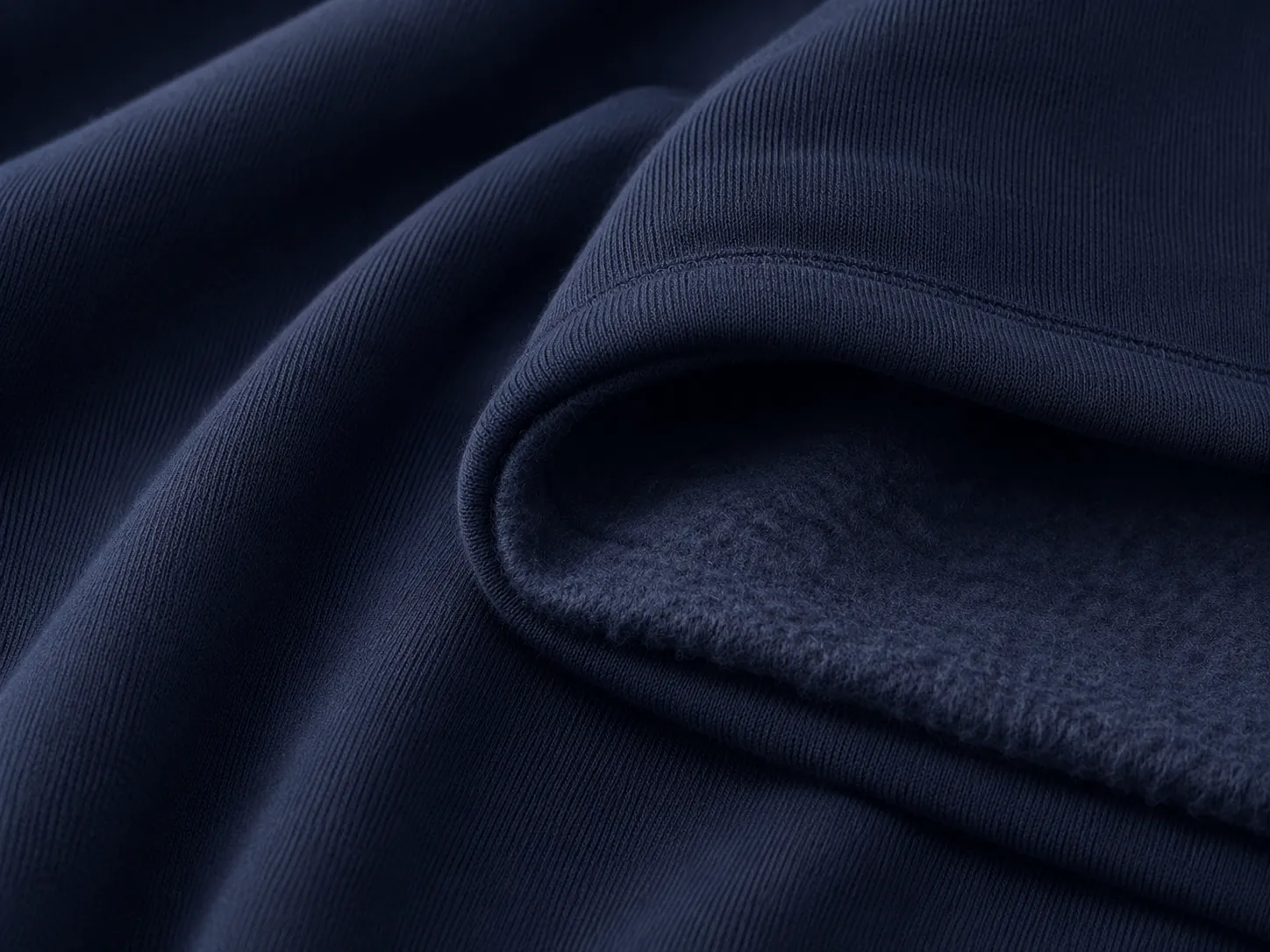
A two-thread structure has one ground (face) yarn and one binding yarn. The binding yarn forms small loops on the inner face; in its greige state this is called french terry (looped sweat). A three-thread structure has, in addition to these, a thicker third yarn that feeds the inner face. This third yarn adds volume and fullness to the fabric; after the brushing (raising) process it becomes a soft, raised backing and the fabric takes on a fleece (raised sweat) character.
On the knitting side, sweat fabrics are generally produced on weft-knitting machines with a single jersey base, building extra feeder yarns onto a single jersey foundation. Loop geometry, yarn count and knit density (weight) together determine the final character of the fabric. Under the same "three-thread" definition, you can produce both a thin summer french-terry-like fabric and a thick winter polar backing; the determining factors are yarn count and weight.
What is the difference between french terry and fleece?
Most of the confusion stems from the shortcut equation "two-thread = french terry, three-thread = fleece". While this is mostly true in practice, it is not a strict rule. There are two determining variables: the knit (number of feeder yarns / fullness) and the finishing (whether or not the inner face is brushed).
French terry is the fabric whose inner face is left in greige loop form. The loops form a terry-like texture, the fabric is relatively thin and allows air circulation. For this reason it is preferred in mid-season hoodies, lightweight sweats and products where a more "structured" look is wanted.
Fleece, on the other hand, is the version in which the inner loops are cut and raised through the brushing process. The air trapped between the fibres forms an insulation layer; the fabric becomes softer, more voluminous and noticeably warmer. The classic winter hoodie and sweat backing is usually this brushed three-thread fleece.
In short: french terry defines a greige/finishing state (unbrushed terry face), while fleece defines a brushed, raised face. Two-thread french terry and three-thread fleece are the two most common combinations, but a three-thread fabric can also be left in a terry character without brushing.
| Property | Two-Thread (French Terry) | Three-Thread (Fleece, brushed) |
|---|---|---|
| Feeder yarns | Ground + binding (2) | Ground + binding + filling (3) |
| Inner face | Looped/terry (loop), unbrushed | Raised/brushed (brushed) |
| Typical finishing | Unbrushed after finishing | Brushing + sanforising |
| Heat retention | Low–medium (mid-season) | Medium–high (winter) |
| Breathability | Higher | Lower (more insulating) |
| Appearance | Thinner, structured, "clean" | Fuller, softer, casual |
| Typical product | Lightweight hoodie, summer/mid-season sweat | Winter hoodie, heavy sweat, tracksuit |
How is weight chosen and which product does it suit?
Weight (g/m², GSM) is perhaps the most practical decision variable in sweat fabric selection. Since both thin and thick fabrics can exist under the same "three-thread" definition, the buyer usually first sets the target GSM range and then builds the structure and yarn choice on top of it. The weight/GSM guide, which covers the logic of weight and the measurement method in detail, provides the basis for this decision.
As a general approach, lightweight french terry products are positioned in a lower GSM band, and winter brushed fleece products in a higher GSM band. However, since each facility's machine park, yarn count and knit density differ, more than one structure may suit a given GSM target. For this reason the table below shows the typical positioning of the structures; let us clarify the exact values on a product basis.
| Use / Product | Typical structure | Inner face | Weight tendency |
|---|---|---|---|
| Summer / mid-season hoodie | Two-thread french terry | Looped, unbrushed | Lower GSM |
| Classic seasonal sweatshirt | Two–three thread (terry or light brushing) | Looped or lightly raised | Medium GSM |
| Winter hoodie | Three-thread fleece | Brushed, raised | Higher GSM |
| Heavy tracksuit / outdoor sweat | Three-thread fleece (thick yarn) | Densely brushed backing | High GSM |
| Structured/"clean" oversize hoodie | Heavy french terry (unbrushed) | Pronounced terry texture | Medium–high GSM |
As weight increases, the fabric becomes heavier, its drape stiffens and its heat retention rises; as it decreases, a more fluid, lightweight and breathable handle is achieved. In oversize fits, heavy french terry gives a "structured" stance, while in body-hugging fits a lower-weight soft fleece may be more comfortable. For this reason the weight decision should be made not only in terms of warmth but together with the fit and desired drape.
How is the relationship between inner face, brushing and warmth established?
How "warm" a sweat fabric is depends less on its thickness than on how much air the inner face traps. Brushing (raising/brushing) combs and raises the surface of the filling yarn in the three-thread structure with wire-covered cylinders. This raised layer provides insulation by creating still-air pockets. Of two fabrics of the same weight, the brushed one feels noticeably warmer than unbrushed french terry.
The yarn choice also changes the inner-face character. Fabrics knitted with combed yarns give a cleaner surface less prone to fuzzing, while carded yarns provide a fuller, more voluminous and "vintage" handle. Brushing intensity (single pass, multiple pass) adjusts the pile length and softness; since excessive brushing can adversely affect strength and pilling resistance, a balance is sought between surface softness and durability.
Dimensional behaviour is also closely related to finishing. Since sweat fabrics can show a tendency to shrink in washing, dimensional stability is brought under control with sanforising (compacting) and measured finishing. Rib is also used for cuff/waistband (rib) areas; the main fleece body and the elasticity of the cuff must complement each other.
If stretch is expected, adding a small proportion of elastane can increase stretch and recovery; however, classic hoodies/sweats are mostly produced without elastane and the elasticity comes from the knit structure. When it comes to colour, because the pile structure of the brushed face refracts light differently, a perceptual tone difference can occur between the face and the inner face; for this reason it is recommended that both faces be evaluated on the approval sample.
How do I choose the right fabric for a hoodie and sweat?
In practice, answering a few questions in sequence makes the decision easier. For which season? If a mid-season and lighter stance is wanted, two-thread french terry; if winter and warmth are the priority, three-thread fleece is a strong candidate. Which drape? Structured, upright oversize fits benefit from a higher weight; soft fits close to the body benefit from a more fluid fabric.
What should the inner-face feel be like? Terry is preferred for a clean terry texture and a "premium clean" look; brushed fleece is preferred for a soft, warm and casual backing. On the yarn side, combed is preferred when a clean surface and print/transfer sharpness matter; carded suits when a full, voluminous and natural look is wanted. We cover this whole product family and the fit–fabric relationship more broadly in the sweatshirt and hoodie fabric guide.
On the performance side, topics such as pilling/surface durability, colour fastness and dimensional stability are secured with a test plan. These checks are critical so that the fabric keeps its appearance and dimensions even after many washes; the target fastness and test classes should be defined before the order.
| Decision criterion | Points towards french terry | Points towards fleece (brushed) |
|---|---|---|
| Season | Spring/autumn, temperate | Winter, cold climate |
| Inner-face feel | Looped terry, cooler | Raised, soft, warm |
| Appearance | Structured, clean, "clean" | Full, casual, relaxed |
| Breathability priority | High | Lower (insulation first) |
| Typical weight tendency | Low–medium | Medium–high |
| Example product | Lightweight hoodie, summer sweat | Winter hoodie, heavy tracksuit |
What are the most frequently asked technical distinctions?
Is three-thread always fleece? No. A three-thread knit, if not brushed, can remain a non-raised, full terry character. The name fleece defines the brushed, raised face; for this reason "three-thread" on its own does not guarantee that the inner face is raised. The order definition must clearly state both the number of threads and the brushing status.
Is french terry always thin? No. French terry can be a thin and breathable fabric at a low weight, but it can also be a thick, structured "heavyweight terry" at a high weight. The thinness comes from the weight, not from the name of the structure. For this reason quite different handles can be found under the same structure name.
Is two-thread or three-thread more durable? Durability depends not on the number of threads alone, but on the yarn quality (combed/carded), the knit density, the brushing intensity and the finishing. An over-brushed fleece face can fuzz and pill more quickly, while a balanced-brushed fabric can keep its form for a long time. The correct comparison is made on the basis of target test classes.
Which is more suitable for printing/embroidery? For transfer/digital prints that want a clean, flat face, unbrushed terry with a flatter surface is often advantageous; however, the face side of fleece fabrics can also be made suitable for printing with appropriate finishing. The decision should be made on a sample basis according to the printing technique and the desired surface sharpness.
Frequently asked questions
What is the basic difference between two-thread and three-thread fabric?
The difference lies in the number of feed yarns added to the ground yarn in the sweatshirt knit. Two-thread fabric has a ground yarn plus a binder yarn; the binder yarn leaves towel-like loops on the inner face. Three-thread fabric adds a heavier fleece (laying-in) yarn that feeds the inner face; this yarn gives the fabric body and, once brushed, turns into a fluffy lining. So the difference is the loft of the inner face and its thermal capacity.
Are French terry and fleece the same thing?
No. French terry is a relatively thin, breathable fabric that carries unbrushed loops (a towelling texture) on its inner face. Fleece is the heavier, warmer version in which the inner loops have been broken open and napped by brushing. The same knit, most often three-thread, gives a fleece character when brushed and a terry character when left unbrushed. The difference comes mainly from the finishing choice, not from the name of the structure.
Is three-thread always fleece and French terry always thin?
No, neither is a hard rule. An unbrushed three-thread knit can stay a non-napped, full-bodied terry; the name fleece describes only a brushed, napped surface. French terry can be thin at a low weight but can equally be a thick heavyweight terry at a high weight. Thinness comes from the weight. A fabric must be defined by the trio of structure plus finishing plus weight, not by the name alone.
How should I choose the weight (GSM), and which product does it suit?
Even within the same structure, weight is the main parameter that determines thinness and warmth. In practice the target GSM range is set first, and then the structure and yarn are built on top of it. Lightweight French terry products sit in a lower GSM band, while winter brushed fleece products sit in a higher GSM band. Since exact ranges shift with the yarn and the knit, they should be confirmed on a sample; the decision is driven not by warmth alone but together with the pattern and the desired drape.
How does brushing affect heat retention?
Heat retention comes less from thickness than from the inner face's capacity to trap air. Brushing (raising/napping) combs and naps the three-thread fleece yarn with wire-covered rollers; the still air trapped between the fibres forms an insulating layer. That is why brushed fleece is noticeably warmer than an unbrushed terry of the same weight. Fine or coarse yarn, brushing intensity and weight together determine the final warmth.
Which fabric is more suitable for printing and embroidery?
For transfer and digital prints that need a clean, flat face, an unbrushed terry with a flatter surface is often advantageous; where print/transfer sharpness matters, a combed (ring-spun) yarn is preferred on the loop side. However, the face side of fleece fabrics can also be made print-ready with the right finishing. The decision should be made on a sample, according to the print technique and the desired surface sharpness.