
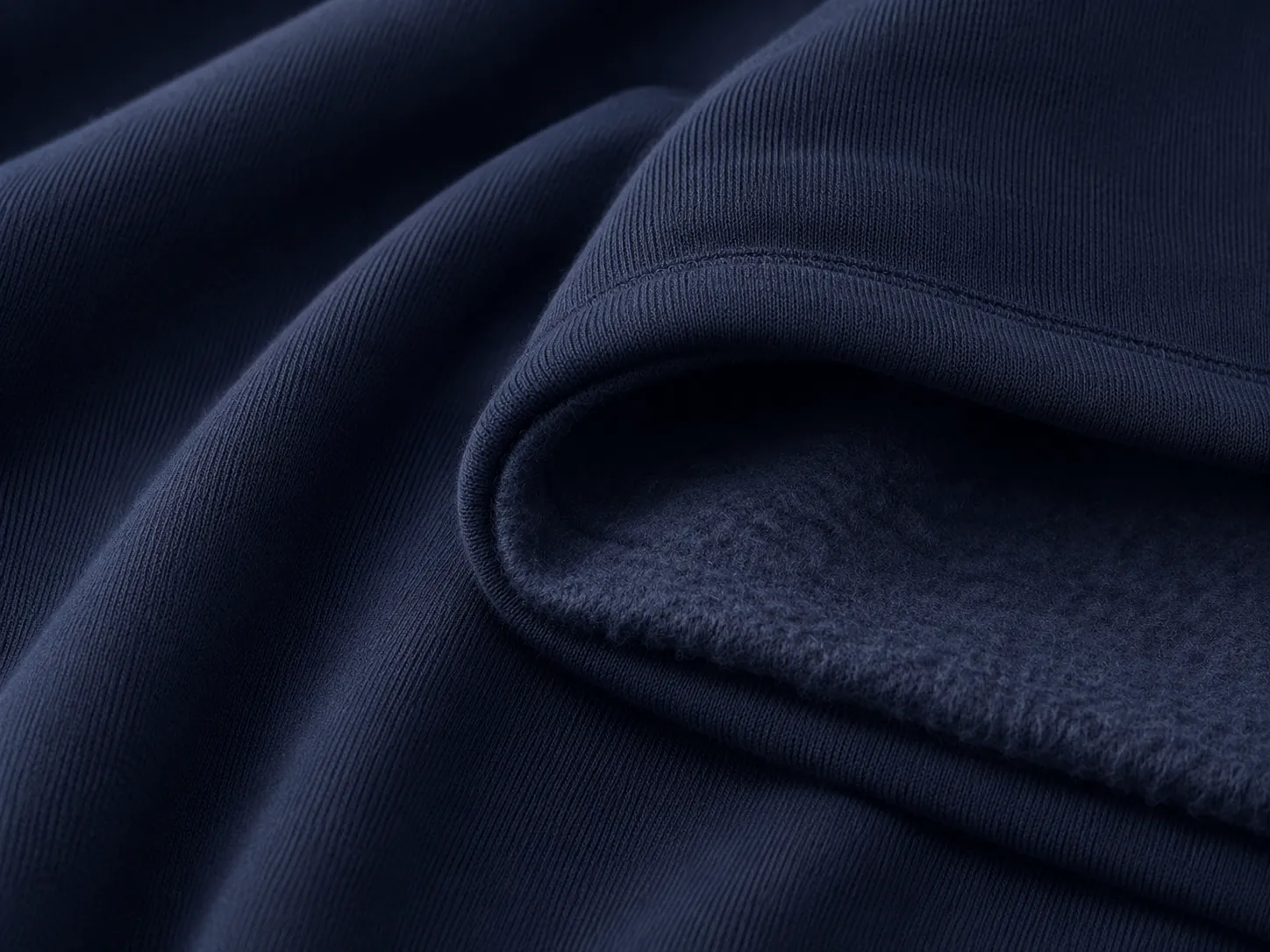
The sweatshirt, hoodie and tracksuit group is the most misunderstood family of knitted fabrics. Requests such as "make it thick" or "a chunky sweat" land at the workshop; yet hand feel and warmth are not determined by a single number but by the combined decision of three variables: the thread system (2-thread / 3-thread), the inner-face treatment (brushed or plain) and the weight. When these three are set up correctly, a 280 g/m² hoodie can feel fuller and warmer than a poorly engineered 340 g/m² product.
The sections below address the selection questions most often asked by sourcing and product development teams in an answer-first approach. We have linked to the Glossary for the technical equivalents of the terms, and to the weight/GSM guide for the full logic of fabric weight.
What is the basic difference between 2-thread and 3-thread fabric?
"Thread" here refers not to the count of the yarn but to the number of feeds that build the fabric's structure on the knitting machine. Two-thread (the lighter variant of French terry) gives a plain, single jersey-like appearance on the face and a light loop texture on the back. Fewer threads means lower weight and a softer drape; this makes it ideal for transitional-season sweatshirts, hoodless basics and layering products.
Three-thread (three-thread fleece) builds a thicker base thanks to the third yarn added to the ground. This third yarn is usually chosen with more bulk, and the back of the fabric is raised and napped through brushing. The result is a lining that traps air inside, feels cottony against the skin and offers high thermal insulation. The de facto standard for hoodies, winter sweatshirts and heavy tracksuits is 3-thread.
A practical distinction: while 2-thread can often be sold as "French terry" in its greige state too, 3-thread is almost always brushed and turned into fleece (a soft, polar-like lining). Yarn quality is decisive here as well; a 3-thread knitted with combed yarn gives both a cleaner surface and less pilling (pilling) than its carded-yarn counterpart.
| Feature | 2-Thread | 3-Thread (Brushed) |
|---|---|---|
| Feed structure | Ground + binding yarn | Ground + binding + loop (laying-in) yarn |
| Inner face | Plain or lightly looped (terry) | Brushed, fluffy fleece |
| Typical weight | 220-320 g/m² | 280-420 g/m² |
| Warmth / fullness | Medium, seasonal | High, winter |
| Drape (hang) | Softer, more fluid | Stiffer, fuller-bodied |
| Typical use | Thin sweat, layering, light hoodie | Hoodie, winter sweat, heavy tracksuit |
What does a brushed inner face do, and for which products should it be chosen?
Brushing is the most effective finishing step for raising perceived quality and warmth without increasing weight. The pile height is controlled by the brushing intensity (single pass / multiple passes); a light brush keeps a clean print surface, while heavy brushing gives a polar-like "peach/fleece" feel. However, since heavy brushing can affect print sharpness and dimensional stability on the face, the balance must be considered in print-heavy collections.
Brushing also carries a cost of fibre shedding and abrasion risk; that is why yarn selection is critical. Using combed or compact yarn on 3-thread grounds that are to be brushed improves both fibre anchorage and long-term surface durability. Where functional performance of the inner face is required (moisture management, etc.), the absorbency of the brushed surface can be balanced with a hydrophilic finish.
Brushed or unbrushed: quick decision criteria
- Maximum warmth / winter: 3-thread, heavy brushing.
- Four-season, multi-purpose: 2-thread or lightly brushed 3-thread, medium weight.
- Print/processing priority, thin look: unbrushed 2-thread terry.
- Premium hand feel, minimum bulk: compact-yarn, controlled light brushing.
What is the typical weight range for a sweatshirt, and how is it chosen?
Weight (g/m², GSM) alone does not define quality; at the same weight, different yarn and knit density give a very different hand. Even so, weight is the backbone of the sourcing specification and must be stated together with the GSM tolerance. Typically ±5% is a reasonable production band; a tighter tolerance means tighter process control and a cost impact.
Another critical point is the weight-wash relationship. Brushed fleece surfaces compact slightly in the first washes; that is why sanforising / compacting and dimensional stability tests (shrinkage allowance) are as important as the final weight. To tie the weight choice to the product's real use, you can also review the product-fabric matching in the product and fabric selection guide.
| Product | Fabric (thread system) | Typical weight (g/m²) | Inner face |
|---|---|---|---|
| Light / seasonal sweatshirt | 2-thread (terry) | 220-260 | Plain or light brushing |
| Standard everyday sweatshirt | 2-thread | 260-300 | Light-medium brushing |
| Heavy / full sweatshirt | 2-thread (dense knit) | 300-320 | Medium brushing |
| Standard hoodie | 3-thread (fleece) | 280-340 | Medium-heavy brushing |
| Heavy / winter hoodie | 3-thread (fleece) | 340-420 | Heavy brushing |
| Tracksuit bottom (jogger) | 2 or 3-thread | 260-340 | Light-medium brushing |
Which weight and structure is the right choice for a hoodie?
The hoodie differs structurally from the sweatshirt: the hood, kangaroo pocket and rib details place additional mechanical load on the fabric. A very low-weight 3-thread can spoil the design intent by leaving the hood "low" and limp; for this reason, weight in a hoodie is both a thermal comfort and a form/posture decision. The choice of rib at the cuff, hem and hood edge also completes the whole; rib is usually planned in a 1x1 or 2x2 structure, in a colour and elasticity compatible with the body.
If elasticity is expected (for example a slim-fit hoodie or models with high freedom of movement), grounds with a small proportion of added elastane can be preferred; in this case dimensional stability and spirality (twisting) control become even more important. For the details of elastane knitting behaviour you can refer to the elastane/spandex knitting page.
Questions to ask when determining hoodie weight
- Which season? Transitional season 280-320; harsh winter 340-420 g/m².
- Should the hood stand upright? Higher weight + a suitable rib supports the structural posture.
- Is printing/processing heavy? A balance must be struck between heavy brushing and large print area.
- Price segment? Combed/compact yarn gives a premium hand feel; carded provides a cost advantage.
How is fabric planned for a tracksuit (jogger) set?
The most common field issue with set products is the tonal difference between the top and bottom pieces. When the same recipe is knitted and dyed in different baths, a visually distinguishable colour deviation can occur. Because KARCEM knits in-house and coordinates contract dyeing/printing/finishing through a vetted contract network under one point of contact, set pieces can be tied to a ΔE<1 target through the same bath or a controlled laboratory approval (lab-dip). For the measurement logic of colour consistency, see the colour fastness and ΔE page.
The jogger cuff rib, waistband and pocket combination should be selected in harmony with the fabric weight: a thin rib on a very heavy ground, or the reverse, gives a weak result in both aesthetics and durability. Writing this structural integrity into the specification from the start shortens the sampling rounds.
Fibre and sustainability choices in sweatshirt and hoodie fabric
The fibre decision determines both performance and certification claims. While pure cotton gives the softest hand, a polyester addition reduces the shrinkage allowance and keeps the fleece's form longer. For recycled-content claims (for example "X% recycled polyester"), the traceability chain and certificate scope must be required; the compliance of marketing statements with regulation is being scrutinised ever more strictly. You can find which claim each member of the certificate family (GOTS, OCS, GRS, RCS) supports on the GOTS/RCS and carbon page, and the general framework in the sustainability and regulation guide.
| Ground choice | Key feature | Point to watch |
|---|---|---|
| 100% cotton (combed) | Softest hand, breathable | Shrinkage allowance management (sanforising essential) |
| Cotton-polyester (e.g. 80/20) | Form retention, low shrinkage | Hand is a touch firmer than cotton |
| Organic cotton | GOTS/OCS claim | Chain-of-custody documents required |
| rPET / recycled | GRS/RCS claim, sustainability | Content ratio + certificate scope must be clarified |
Critical parameters that must be written into the specification
For correct sampling and repeatable production, a sweat/hoodie specification is expected to contain at least the following headings. This list is a control point that shortens sampling rounds and prevents surprise deviations:
- Thread system: 2-thread / 3-thread and yarn type (combed/carded/compact).
- Weight and tolerance: target g/m² + GSM tolerance (e.g. ±5%).
- Inner face: brushed/unbrushed, brushing intensity.
- Fibre composition: cotton/polyester/elastane ratios, certificate scope.
- Colour target: ΔE<1 and colour fastness grades.
- Dimensional stability: post-wash shrinkage allowance limits.
- Trim compatibility: rib structure, drawcord, hood lining.
Once these parameters are clear, the sampling and delivery process becomes more predictable. Since specific price, MOQ and lead-time figures vary with the structure of the order, rather than assuming them fixed from the outset it is healthiest to clarify them per project. If you would like to see the sweat/hoodie family compared with other product groups, you can also look at the t-shirt, polo and activewear/leggings fabric guides.
Hoodie & sweatshirt fabric we manufacture — composition and GSM
As a hoodie & sweatshirt fabric manufacturer and supplier in Turkey, KARCEM knits greige fabric on its own circular machines and coordinates dyeing, printing and finishing across an audited contract network. Typical constructions and weight ranges we produce:
| Composition | Weight (g/m²) | Width | Typical use |
|---|---|---|---|
| 2-thread French terry | 240–320 | Tubular | Light sweat, summer hoodies |
| 3-thread fleece (brushed) | 300–420 | Tubular | Winter hoodies and sweatshirts |
| Cotton / poly blend terry | 260–360 | Tubular | Workwear and promo hoodies |
| Organic / recycled loopback | 280–380 | Tubular | Sustainable ranges |
Capacity, MOQ and lead time
Group knitting capacity is around 450 tonnes per month, so we serve both low-MOQ development runs and high-volume repeat programmes. MOQ is not a single figure — it is defined per colour, weight and process together, so a realistic minimum becomes clear once we see your combination. Lead time depends on quantity, finish and dye-lot planning and is confirmed with your quote. See our MOQ, sampling and lead-time and lab-dip approval pages, then request a hoodie & sweatshirt fabric quote with your composition, GSM and quantity.
Certifications and compliance
We work with GOTS, OCS, GRS and RCS certified processes and BCI cotton. Colour is targeted at ΔE<1 versus the approved lab dip, with fastness and dimensional-stability testing available on request. See our certificates and colour-fastness pages for detail.
OEM, private-label and export
KARCEM supplies hoodie & sweatshirt fabric as an OEM and private-label knit fabric manufacturer: greige-to-finished production under your specification, ready for your own cut-and-sew or garment supplier. We export knit fabric from Turkey to the EU, UK, Middle East, North America and Russia on EXW, FOB or CIF terms. For programme pricing per kilogram, share your annual volume and target constructions.
Frequently asked questions
What is the minimum order quantity (MOQ) for hoodie fabric?
MOQ is flexible and set per colour and construction. We handle development lots and high-volume repeat orders; share your terry/fleece type, GSM and quantity and we confirm the minimum with the quote.
What does the brushed (fleece) inner face do?
Brushing the loopback raises a soft, warm inner surface — the difference between a light 2-thread summer hoodie and a warm 3-thread winter one, without changing the outer face.
Can you supply organic or recycled hoodie fabric?
Yes. We produce loopback and fleece in GOTS/OCS organic cotton and GRS/RCS recycled blends, supplied with valid transaction certificates.
Do you export sweatshirt and hoodie fabric?
Yes. We export sweat and hoodie fabrics from Turkey to the EU, UK, Middle East, North America and Russia on EXW, FOB or CIF terms.
What is the basic difference between 2-thread and 3-thread fleece?
The difference lies in the number of yarns feeding the back of the fabric. In 2-thread fleece there is a ground yarn plus a binder (tie) yarn, producing a thinner, more flexible structure. In 3-thread fleece there is an additional pile yarn, and this third yarn is brushed to create a soft, lofted lining on the inside. In short, 3-thread fleece is fuller, warmer and well suited to brushing.
What are the typical weight ranges for sweatshirts and hoodies?
The classic industry norm for sweatshirts is 220-320 g/m² in 2-thread: seasonal basics 220-260, standard everyday 260-300, heavyweight sweats 300-320. For hoodies the de facto standard is 3-thread brushed fleece, with everyday hoodies in the 280-340 band and heavy/winter hoodies at 340-420 g/m². For joggers the typical band is 260-340 g/m².
What does the brushed inner face do?
Brushing is the process of raising the yarn fibres by carding the back face of the fabric with fine wire teeth. The trapped air delivers higher thermal insulation at the same weight and a soft hand against the skin; it is the most effective finishing step for raising perceived quality without adding weight. Because heavy brushing can affect print sharpness and dimensional stability, a balance must be struck in print-led collections.
How is the shade difference between the top and bottom of a tracksuit prevented?
In matching sets, the most common field issue is the shade difference that arises when the same recipe is run in different dye baths. In KARCEM's single-point-of-contact model, knitting is in-house and commission dyeing/printing/finishing run through a vetted contract network, so the pieces of a set can be tied to a ΔE<1 target by running them from the same dye bath or through a controlled lab-dip approval. Writing this into the specification from the outset shortens the sampling rounds.
What GSM tolerance is considered reasonable for sweat/hoodie fabric?
Weight alone does not define quality, but it is the backbone of the purchasing specification and must be stated together with a GSM tolerance. Typically ±5% tolerance is a reasonable production band; a tighter tolerance means tighter process control and a cost impact. Because brushed fleece compacts slightly in the first washes, sanforising/compacting and shrinkage tests are as important as the final weight.
Which parameters must always be specified in a sweat/hoodie specification?
For repeatable production the specification should contain at least the following: yarn system and type (2/3-thread; combed/carded/compact), target weight plus GSM tolerance, inner face and brushing intensity, fibre composition and certification scope, colour target (ΔE<1 and colour fastness ratings), post-wash shrinkage limits, and trim compatibility (rib, drawcord/cord, hood lining).