
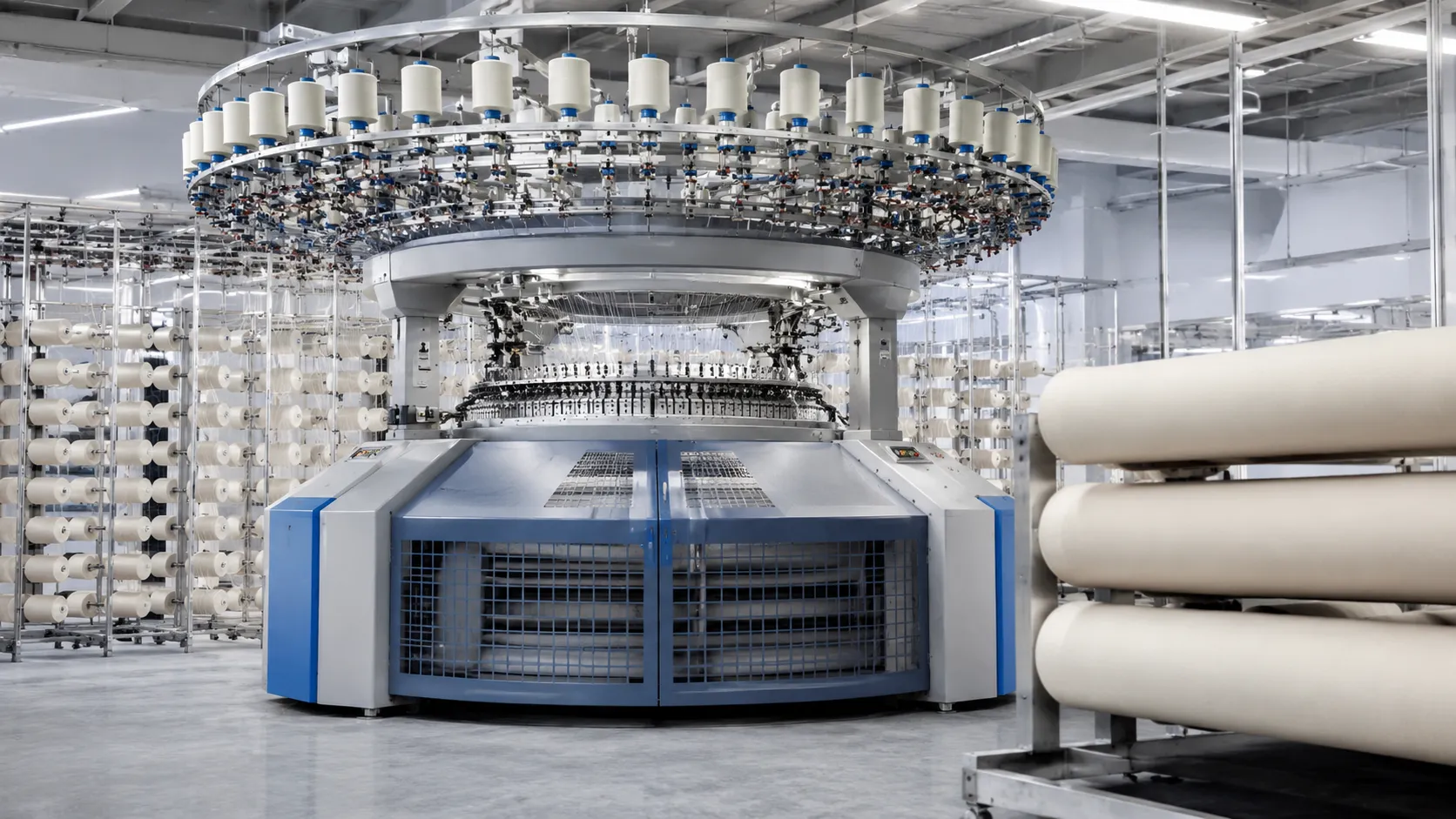
A T-shirt drooping off the shoulder after washing, a polo collar that ripples in its first season, or a hoodie whose inner face turns out thinner than expected; almost all of these are the result of an early decision made during fabric selection. In knitted fabric, the choice of type, GSM, yarn and composition are interlinked: change one and the hand, dimensional stability and cost change too. This pillar guide classifies the families in the fabric catalogue, shows which one is right in which situation, and points you to the relevant comparison articles when you want to go deeper.
Knitted fabric families
Knitted fabrics divide into a few main families according to needle arrangement and knit structure. Each family offers a different hand, stretch and GSM window. The short introductions below are a starting point; for detailed comparisons, see the linked articles.
Single jersey (süprem)
Single jersey is the most basic structure, knitted on a single needle bed: smooth on one face, looped on the other, lightweight and breathable. It is the backbone of T-shirts and underwear, typically working in the 120–180 g/m² range. With added elastane it becomes elastane single jersey and holds its shape in body-hugging patterns. We address how it differs from interlock and which is suited to which end use in our single jersey vs interlock comparison.
Interlock
Interlock is a double-bed structure in which two needle beds work interlocked; both faces are smooth and full, and it does not curl. Because it is more stable and more opaque than single jersey, it is preferred for quality T-shirts, babywear and underwear. Its typical GSM is 180–260 g/m².
1×1 rib (ribana) and 2×2 rib (kaşkorse)
1×1 rib is an elastic knit in which one face stitch and one reverse stitch form the wale; it stretches considerably across the width, which is why it is used in collars, cuffs and waistbands. 2×2 rib, by contrast, is a derivative knitted with a two-by-two wale arrangement, with more pronounced texture and usually containing elastane; it stands out in pieces such as bodysuits and fitted dresses. The two structures differ in wale density, stretch behaviour and field of use; we explain the distinction in the 2×2 rib vs 1×1 rib differences article.
Two-thread and three-thread fleece
Two-thread fleece is a durable, lightweight, raisable/brushable knit; it is the basis of the sweatshirt and tracksuit-top group (typically 220–320 g/m²). Three-thread fleece gains a thicker inner face thanks to an extra binding thread; when raised it becomes soft and warm, which is why it is used for heavier hoodies and sweatshirts (typically 280–420 g/m²).
Piqué and jacquard
Piqué, with its honeycomb-like textured surface, is the classic fabric of polo shirts and corporate wear (typically 180–240 g/m²). Jacquard is a structure in which the pattern is worked directly into the knit; with its mélange effects and fluid hand it finds a place in fashion-led womenswear. Both structures lead with their surface character.
Decision framework: four axes
Once you have chosen the family, getting clear on four axes will lead you to the right specification. These axes affect one another; when one changes, review the others again.
| Axis | What to ask | Practical impact |
|---|---|---|
| GSM (g/m²) | What is the finished g/m² target? | Determines lightness, opacity, drape and cost. For choosing a range, see the GSM guide. |
| Composition | 100% cotton or a blend? | Changes the hand, moisture management, dimensional stability and fastness behaviour. |
| End use | What is the product, and how will it be worn? | Underwear, outerwear, polo or bodysuit each call for a different structure. |
| Stretch | Is elastane needed, and how much? | Decisive for how the pattern hugs the body and recovers. For detail, see the elastane guide. |
In practice the sequence usually starts from the end use: you define the product and the way it is worn, from which the family and stretch requirement follow, and then you fine-tune the hand with GSM and composition. For a T-shirt, the choice between 150 g/m² single jersey and 220 g/m² interlock is not just weight; it is a difference in opacity, drape and perceived quality.
Finishing and fastness expectations
A knitted fabric's story does not end on the machine. The greige fabric that comes off the machine acquires its colour and final hand in the finishing process: pre-wash, dyeing, finish and, where needed, raising. Setting the chain up correctly ensures the fabric both stays as it looks and behaves in the wash as expected.
- Colour consistency: In reactive or disperse dyeing, the aim is to keep within-batch and batch-to-batch colour deviation under control in terms of ΔE (Delta E). At KARCEM this tolerance is run with a ΔE<1 target; in practice this means that on a repeat order the colour remains visually indistinguishable.
- Fastness: Wash, rubbing and perspiration fastness show how permanent the colour stays over the product's service life. Fastness expectations vary by end use; the threshold is higher for babywear and frequently washed underwear.
- Dimensional stability: Shrinkage and width settle during the finishing and sanforising steps. The tolerance is typically framed as ±5% in GSM and a few centimetres in width.
Guides in this pillar
Single Jersey vs. Interlock: Which Should You Choose for Your Collection?
The structural difference between single jersey and interlock, plus GSM, drape, dimensional stability and edge curling. Choose the right knit fabric…
Structural Differences Between 2×2 Rib and 1×1 Rib
Structural differences between 1×1 rib (ribana) and 2×2 rib (kaşkorse): widthwise stretch, hand, cuff-collar-waistband use and the effect of…
How Does GSM Affect a Fabric's Quality and Drape?
What is GSM, how is it measured, and how does it affect drape, hand, durability, opacity and cost? A guide to typical GSM ranges by product type and…
Stretch, Recovery and Dimensional Stability in Elastane Knit Fabrics
Elastane content, the difference between stretch and recovery, dimensional stability, shrinkage and heat control in dyeing and finishing elastane…
Pique, Lacoste and Jersey: The Right Knitted Fabric for Polo Collars
Differences in surface, texture and stability between pique, lacoste and jersey knits. Which fabric, which weight and which collar behaviour is right…
Two-Thread vs Three-Thread (French Terry vs Fleece): Choosing Hoodie and Sweat Fabric
The structure, weight, inner-face and warmth differences between two-thread (french terry) and three-thread (brushed fleece): a practical guide to…
Ponte di Roma and Jacquard Knitting: Special Double-Plate Structures
What are ponte di Roma and jacquard knitting, and how do they differ? Compare the form retention, handle and dress/jacket uses of double-plate…
Dimensional Stability and Spirality (Skew): Shrinkage Control
Causes of spirality (skew) in single jersey knit fabric, dimensional stability, and how sanforising and compacting control shrinkage. A guide with…
Frequently asked questions
Which knit structure and weight should I choose for basic T-shirts and underwear?
For basic T-shirts and underwear, single jersey or interlock is suitable; the typical weight range is 120–220 g/m². Single jersey is light and breathable, with a flat face and a looped reverse; interlock is a double-knit, full-bodied on both faces and curl-free, and because it is more stable and opaque it is preferred for higher-quality T-shirts and underwear.
Is the difference between single jersey and interlock only weight?
No. Single jersey is knitted on a single needle bed, is light and breathable, and typically runs 120–180 g/m²; interlock is a double-knit construction in which two needle beds interlock, it does not curl, is more stable and typically runs 180–260 g/m². For example, the choice between 150 g/m² single jersey and 220 g/m² interlock is not just weight; it is a difference in opacity, drape and perceived quality.
How do you guarantee color consistency; will the color hold on a repeat order?
In reactive or disperse dyeing our aim is to keep within-batch and batch-to-batch color deviation under control, expressed as ΔE (Delta E). At KARCEM this tolerance is run with a ΔE<1 target; in practice this means the color remains visually indistinguishable on a repeat order. We recommend confirming color approval not from a screen alone but together with a physical sample and spectrophotometric measurement.
What tolerances do you work to for shrinkage and width?
Dimensional stability, that is shrinkage and width, is set during the finishing and compacting (sanforizing) steps. The tolerance is typically framed as ±5% on weight and a few centimeters on width. The fastness expectation varies by end use; for baby wear and frequently washed underwear, the wash, rubbing and perspiration fastness thresholds are kept higher.
For hoodies and sweatshirts, two-thread or three-thread fleece, and at what weight?
Two-thread fleece is a durable, lightly brushable knit and is the basis of the sweatshirt and tracksuit-top group (typically 220–320 g/m²). Three-thread fleece gains a thicker inner surface from an additional binding yarn; when brushed it softens and retains warmth, so it is used for heavier hoodies and sweatshirts (typically 280–420 g/m²).
What is the difference between 1×1 rib and 2×2 rib, and where is each used?
1×1 rib is a stretchy knit in which one face and one reverse loop form a wale; it stretches considerably crosswise, so it is used for collars, cuffs and waistbands. 2×2 rib is a more pronounced, textured derivative knitted in a paired wale arrangement, usually with elastane; it stands out in pieces such as bodysuits and fitted dresses. The two structures differ in wale density, stretch behavior and application.
Which fabric for which collection
The pairings below are a starting point; the final choice is always settled on a sample.
| Collection / product | Primary family | Typical GSM |
|---|---|---|
| Basic T-shirt, underwear | Single jersey, interlock | 120–220 g/m² |
| Body-hugging T-shirt, bodysuit | Elastane single jersey, 2×2 rib | 160–300 g/m² |
| Collar, cuff, waistband | 1×1 rib | 180–260 g/m² |
| Sweatshirt, hoodie, tracksuit | Two-thread, three-thread fleece (raised) | 220–420 g/m² |
| Polo, corporate wear | Piqué | 180–240 g/m² |
| Patterned / fluid fashion | Jacquard, mélange | 160–220 g/m² |
Knit structures comparison matrix: composition, weight, use, dyeability
The matrix below gathers KARCEM’s main knit structures in a single table: typical composition, industry-typical weight range, common end use and dye/print behaviour. The values are a starting reference; exact weight and hand vary with yarn count, knit density and finishing, and the final specification is confirmed from a sample. By typing a structure, use or fibre into the search box above the table (for example “polo”, “elastane”, “fleece”) you can instantly filter the rows.
| Structure | Typical composition | Industry-typical weight (g/m²) | Typical end use | Dye / print suitability | Detail |
|---|---|---|---|---|---|
| Single jersey | 100% cotton; cotton/PES; cotton/modal | 110–200 | Basic T-shirt, body, underwear, dress | Reactive dyeing; smooth surface very suitable for digital, rotary and pigment printing | Guide |
| Single jersey with Lycra (+ elastane) | 90–95% cotton + 5–10% elastane | 180–260 | Body-hugging T-shirt, body, women’s top | Reactive; requires elastane fixation control; printing suitable | Guide |
| Interlock | 100% cotton; cotton/modal; cotton/PES | 180–280 | Quality T-shirt, baby/children, polo body, underwear | Very good in reactive dyeing; suitable for double-sided printing, low curling | Guide |
| 1×1 rib | 95% cotton + 5% elastane (usually) | 200–340 | Collar, cuff, waistband; slim-fit top | Mostly dyed; widthwise stretch limits printing | Guide |
| 2×2 rib | 95% cotton + 5% elastane; cotton/PES/elastane | 200–340 | Women’s top, bodysuit, slim-fit garment | Suitable for dyeing; textured surface limits printing | Guide |
| Piqué | 100% cotton; cotton/PES; cotton/elastane | 180–260 | Polo-collar T-shirt, corporate / sports polo | Good dyeing; textured surface limits printing, embroidery preferred | Guide |
| French terry | 100% cotton; CVC (cotton/PES); + elastane | 220–320 | Seasonal sweatshirt, light hoodie, tracksuit | Reactive/pigment; digital and rotary printing good on the smooth outer face | Guide |
| Fleece (brushed) | 100% cotton; CVC; cotton/PES/elastane | 280–400 | Sweatshirt, hoodie (brushed inside), tracksuit | Garment/pigment dyeing common; printing suitable on the smooth outer face | Guide |
| Ponte (ponte-roma) | Viscose/PES/elastane (usually) | 250–360 | Dress, jacket, trousers (structured hand) | Disperse + reactive for mixed fibres; printing limited | Guide |
| Jacquard knit | Variable: cotton or synthetic blend | 200–340 | Patterned sweat, dress, decorative top | Pattern comes from the knit; colour by dyeing; printing usually unnecessary | Guide |
In blended and elastane structures the dye and fixation recipe is adjusted to the fibre; colour consistency is confirmed with a ΔE<1 target and fastness tests. Because KARCEM knits the greige in-house and coordinates the dyeing → printing → finishing steps through a vetted, geographically close contract network under a single point of contact — verifying colour to a ΔE<1 target on the incoming lot — we can develop the structures in the matrix in custom composition and weight with your sample request.
If you want to carry this table with you, download the PDF version of this guide and add it to your sample brief.
Go deeper
The pillar guide gives an overview; we have deepened the points that most often trip people up during a decision in separate articles:
- Single jersey vs interlock comparison — single layer or double bed?
- 2×2 rib vs 1×1 rib differences — wale arrangement and stretch behaviour.
- GSM guide — which g/m² range for which product.
- Elastane and knitting — choosing the right stretch ratio.
For technical terms encountered for the first time, you can refer to the Glossary.
With KARCEM
KARCEM knits greige fabric on its own machines and coordinates dyeing, printing and finishing through a vetted, geographically close contract network; this means a single point of contact keeps the fabric coordinated from its greige state to its finished hand. We make the family you choose concrete in a sample → approval → production flow, and confirm colour consistency with a ΔE<1 target on the incoming lot and with fastness tests. With our commission (CMT) capacity we can develop custom compositions and GSMs. To clarify the fabric suited to your collection, send us your sample and quotation request; let our team guide you so you start with the right specification.