
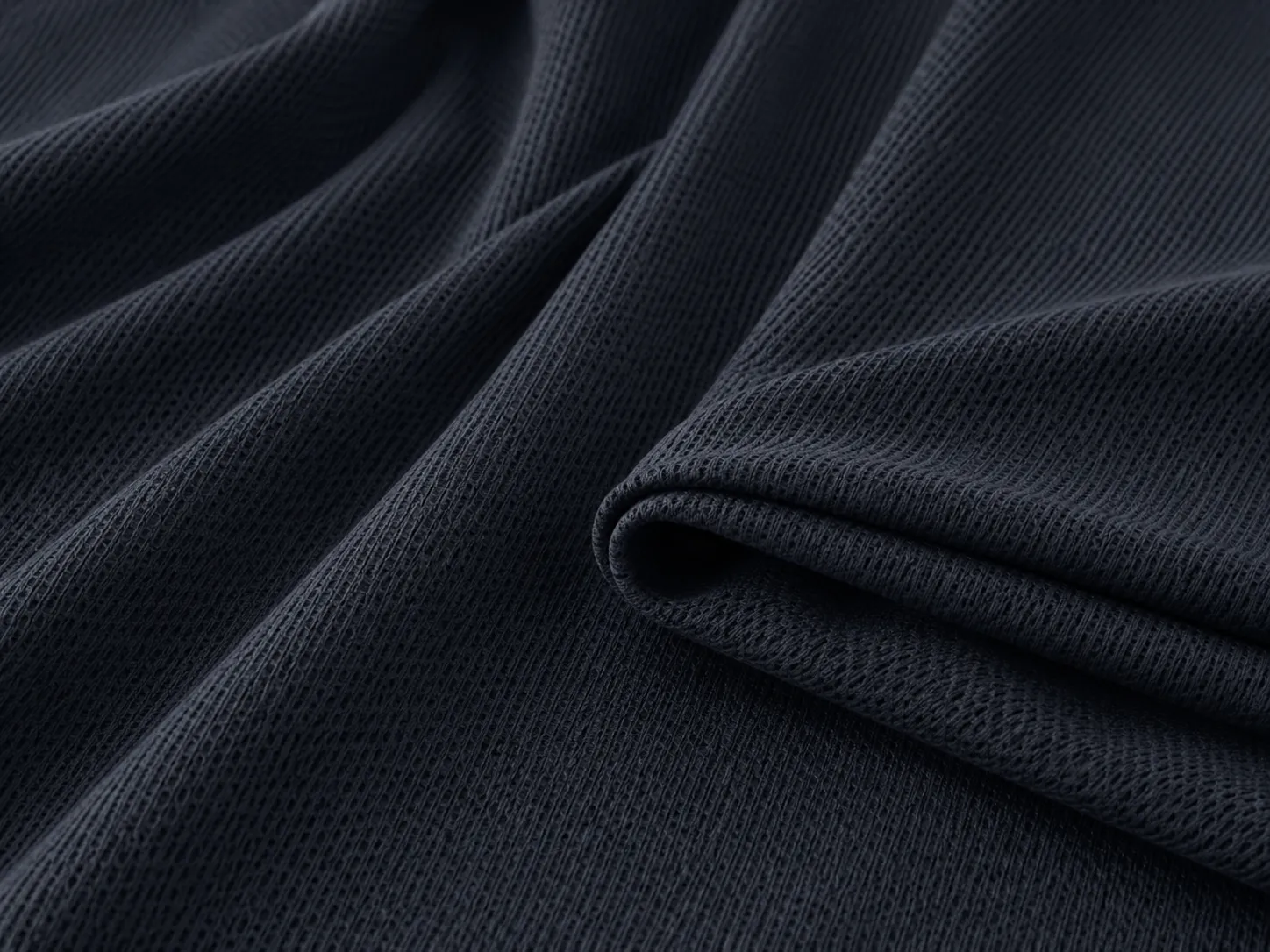
Unlike single jersey knits, double-plate fabrics are formed by interlocking two rows of needles. This gives the fabric a double-faced, thick and dimensionally stable character. The interlock logic we saw in the single jersey versus interlock comparison is also the foundation of ponte and jacquard: front and back faces are bonded together, non-curling and firm. Ponte di Roma and jacquard are two special branches of this family and diverge clearly in both production and end use.
What is ponte di Roma knitting and why does it give such a firm handle?
"Ponte" means bridge in Italian, and the name comes from the yarn bridges in the knit repeat. Classic ponte di Roma is based on a repeat that runs over four feeds on the double needle plate: in some courses a loop is knitted on both plates, while in other courses a loop forms on only one plate and the other passes by as a miss. This imbalance gives the fabric a thicker and less elastic body than interlock.
The firmness of the handle is the combination of three factors. First, the double-plate structure makes the fabric double-faced; the problem of the reverse of single jersey showing does not exist here. Second, the miss movements within the repeat compress the loops and increase the amount of yarn per unit area; this raises the fabric weight. As explained in the fabric weight guide, double-plate fabrics are typically significantly heavier than single-jersey fabrics. Third, the balanced structure eliminates edge curling, which provides clean seam lines and crisp forms in garment making.
Ponte di Roma is usually knitted with a recipe containing elastane. A small amount of elastane gives the fabric recovery; so even when the fabric stretches it returns to its original form and does not bag at the knees or elbows. As we examined in our piece on elastane and knitting, the role of elastane in ponte is not high stretch but a form-preserving recovery.
What is jacquard knitting and how does it differ from ponte?
The fundamental difference between ponte and jacquard is intent. Ponte di Roma is a structural fabric: the aim is to obtain a firm, form-retaining, plain body. Jacquard, by contrast, exists to produce pattern. Because each needle can be selected individually on jacquard machines, yarns of different colours are brought to the surface and withdrawn in a programmed manner; the result is a multi-colour pattern formed directly during knitting, without printing.
In the double jacquard structure the pattern is visible on the face of the fabric, while the unused colours are carried on the back. These carried yarns are bound in (tied) on the back plate; in this way the float length (free-floating yarn) is kept under control and the fabric gains a firm, closed back face. This is the critical feature that distinguishes double-plate jacquard from single jersey jacquard: the back face is even, the yarns are tied off short and the fabric is dimensionally stable.
Jacquard pattern should not be confused with printing. In printing, the colour is applied to the surface afterwards; in jacquard the colour is the yarn itself and is knitted into the structure. This means the jacquard pattern does not fade in washing, does not rub off and is visible on both faces. Because colour fastness comes from in-fibre colour rather than from print, jacquard offers a structural advantage within the logic of colour fastness and ΔE<1.
Structure, property and use comparison
The table below summarises the three core members of the double-plate family, including interlock, in order to position ponte and jacquard clearly.
| Structure | Formation / mechanism | Characteristic property | Typical use |
|---|---|---|---|
| Interlock | Double plate, two faces interlocked, plain knit | Identical on both faces, smooth, balanced, medium firmness | Underwear, babywear, premium T-shirt, bodied top |
| Ponte di Roma | Double plate, four-course repeat with knit+miss | Thicker/firmer than interlock, form-retaining, non-curling, plain | Dress, suit/jacket-like, trousers, blazer |
| Double-plate jacquard | Needle-based pattern selection, coloured yarn carrying | Multi-colour/relief pattern, firm back face, visual | Patterned dress, cardigan, decorative jacket, panel |
How do ponte and jacquard behave in terms of form retention?
Form retention is the area in which double-plate fabrics are strongest. Ponte di Roma standing upright means that, unlike single jersey, it does not "flow" downward and the garment keeps its silhouette. For this reason ponte can provide body on its own in seamed, structured pieces (blazer, skirt, slim-fit dress) without requiring lining. The fabric stretches but reclaims its form thanks to elastane recovery.
In jacquard, form behaviour depends on the pattern. A dense, multi-colour pattern means more yarn carried on the back face; when these yarns are bound in, the fabric thickens and becomes firmer. Jacquards with sparse patterning can be softer and more drapey. Therefore, the answer to "does jacquard hold its form?" is directly related to pattern density and binding frequency. The designer should assess the form requirement together with pattern density.
Dimensional stability matters in both structures. Because double-plate fabrics are balanced, they are far less prone to the spirality (skewing) problem we addressed in the knitted fabric guide than single-jersey fabrics. Even so, there is a risk of shrinkage when the correct finishing and compacting/sanforising are not applied; for this reason, dimensional stability after washing should be verified on the pre-production approval sample.
Recipe and performance comparison
The table below summarises the composition tendencies and performance character of ponte and jacquard. Specific numerical values vary by product and recipe; let us define the precise targets together.
| Criterion | Ponte di Roma | Double-plate jacquard |
|---|---|---|
| Primary purpose | Structure / form (single colour) | Visual / pattern (multi-colour or relief) |
| Typical composition | Viscose/polyester/cotton + elastane | Cotton/polyester/acrylic based, coloured yarns |
| Surface appearance | Plain, slight diagonal/brick texture | Patterned, motifed, legible on both faces |
| Source of stretch | Elastane recovery (for form) | Structural stretch; pattern is usually possible without elastane too |
| Colour fastness logic | Depends on dyeing fastness | Colour is in the yarn; resistant to fading compared with print |
| Form retention | High, stands upright | Depends on pattern/binding density |
| Garment-making behaviour | Non-curling, crisp seams, body without lining | Non-curling; thick patterns require pattern allowance |
For which product should ponte be chosen, and for which jacquard?
The choice is made according to whether the design prioritises body or visual effect. For structured, upright, single-colour pieces (blazer, slim-fit dress, suit skirt, smart trousers), ponte di Roma is ideal; it provides body on its own and reduces the need for lining. When pattern, multi-colour effect or a relief identity is wanted on the surface (patterned dress, cardigan, decorative jacket front, panel details), jacquard is preferred.
The two structures are often complementary. In a collection, ponte can be used as the body fabric and jacquard in decorative areas such as the collar, cuffs or front panel; in this way form and visual identity are combined in a single product. When deciding, the fabric weight target, elastane requirement, pattern density and end-use washing conditions should be assessed together.
From a production standpoint, both structures require a double-plate machine park, correct yarn selection and controlled finishing. In jacquard, pattern programming and colour management additionally come into play; in ponte, repeat selection and elastane balance are critical. Bulk production should not be started without proper sample approval (lab-dip, dimensional stability, fastness).
Frequently asked questions
What is the fundamental difference between Ponte di Roma and jacquard?
Both are produced on double-bed machines (the double-knit / interlock family), but they serve different purposes. Ponte di Roma is a structural knit; it delivers a plain, solid-color, thick, shape-retaining body. Jacquard, by contrast, uses a needle-based patterning mechanism to create multicolored or relief motifs on the surface. In short: ponte is chosen for structure, jacquard for visual effect.
Why is Ponte di Roma such a firm, shape-retaining fabric?
The firmness comes from three factors combined: the double-bed construction makes the fabric double-faced; the miss (float) movements in the four-course repeat compress the loops and increase the amount of yarn and the weight per unit area; and the balanced structure eliminates edge curling. The result is a body that is thicker than interlock, less stretchy, and stands upright.
Is a jacquard pattern the same as a print, and does it fade in the wash?
No. In printing, color is applied to the surface afterward; in jacquard, the color is the yarn itself and is knitted directly into the fabric during the knitting process. That is why a jacquard pattern does not fade in the wash, does not rub off, and is visible on both faces. Because the color is within the fiber, jacquard offers a structural advantage in terms of color fastness and the logic of ΔE<1.
What is the typical composition of Ponte di Roma, and why is elastane added?
Ponte is typically knitted from a viscose/polyester/cotton-based recipe with a small amount of elastane added. The role of the elastane here is not high stretch but recovery: the fabric returns to its original shape even after stretching and does not bag at the knees or elbows. Jacquard, by contrast, is mostly knitted from cotton/polyester/acrylic-based colored yarns and can generally be produced without elastane.
Does jacquard fabric retain its shape, and is it as structured as ponte?
In jacquard, shape depends on the pattern density and on how the yarn is bound on the reverse face. A dense, multicolored pattern means more yarn is carried (floated) on the back; once these are bound in, the fabric thickens, and a tightly bound jacquard holds its shape well. Loosely patterned jacquards are softer and more draping. Ponte, thanks to its float-based repeat, stands upright under any condition.
For which product should we choose ponte, and for which jacquard?
For plain, shape-retaining, structured/jacket-like pieces (blazers, slim-fit dresses, tailored skirts, elegant trousers) Ponte di Roma is ideal; it provides body on its own and reduces the need for lining. When surface pattern, multicolor, or a relief identity is required, jacquard is needed. The two can also be used in a complementary way: ponte for the body, jacquard for decorative areas such as the collar, cuffs, or front panel.