
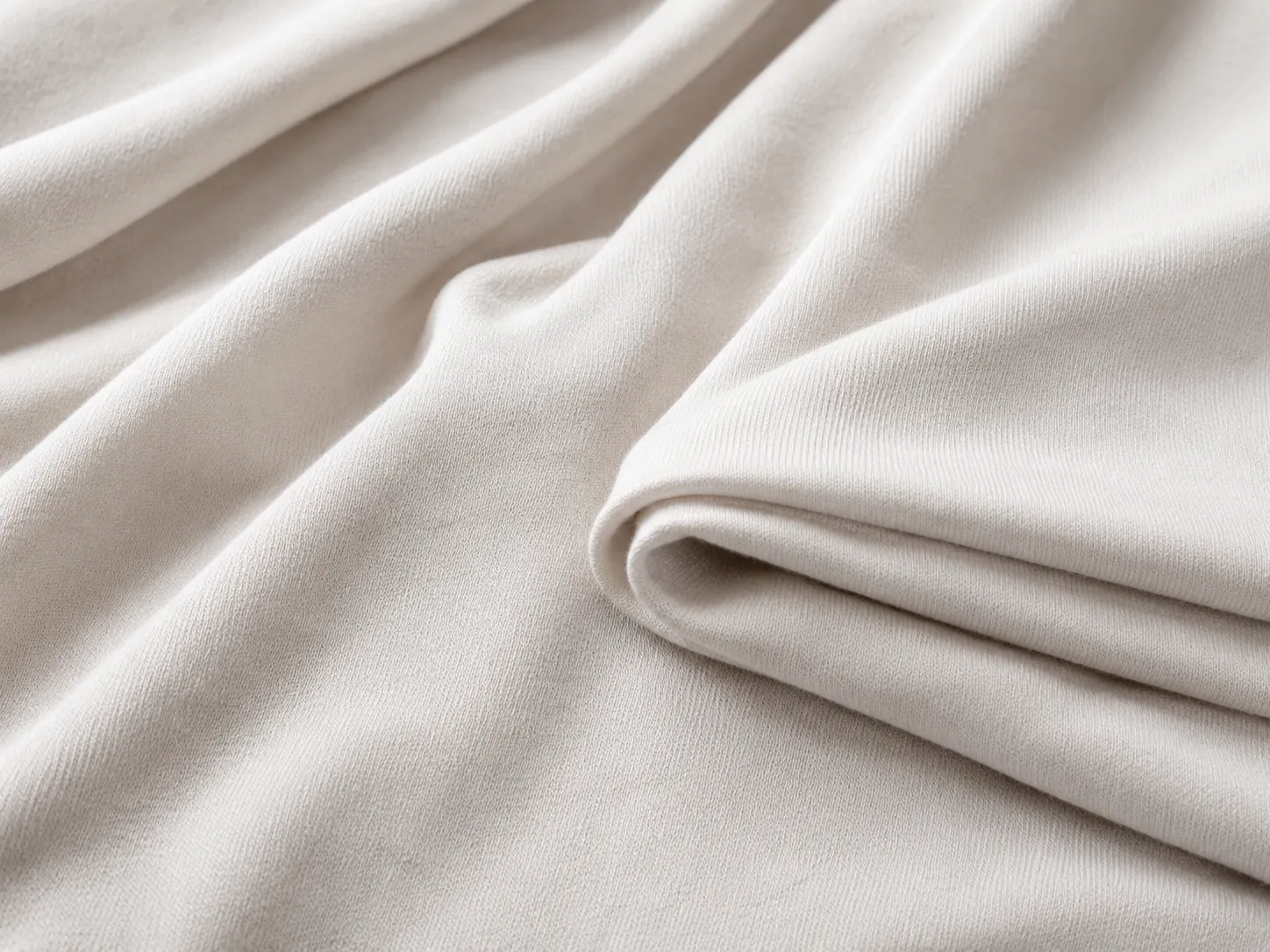
In a t-shirt collection, "fabric" is not a single choice; it is a recipe given jointly by knit structure, weight, yarn count and fibre blend. Most buying teams experience at the sampling stage how the same cotton produces a completely different product feel in a different knit and weight. Below we address the decisions most frequently encountered for t-shirts, with industry-norm ranges and KARCEM's perspective as an in-house knitter that coordinates dyeing, printing and finishing through a vetted contract network.
Which knit for a t-shirt: single jersey, lycra single jersey or interlock?
Single jersey is the most common form of single-plate knit; the face shows loop rows and the back shows a reverse-loop appearance. Thanks to its lightness and cost advantage, it forms the backbone of basic and promotional t-shirts. Its disadvantage is its inherent tendency to curl at the edges and to move dimensionally during washing; for this reason compacting (sanforising) and dimensional stability control are important.
Lycra single jersey carries elastane in the weft direction at a band of 3-8, giving a hand that hugs the form and recovers. It is preferred in slim-fit, women's t-shirts and active-look styles. Interlock, on the other hand, is a double-plate (double jersey) structure: both faces are flat and look identical, fuller, less sheer, with better shape retention. To explore the structural difference between single jersey and interlock in more depth, the single jersey vs interlock comparison page is useful.
| Property | Single Jersey | Lycra Single Jersey | Interlock |
|---|---|---|---|
| Knit structure | Single plate (single jersey) | Single plate + elastane | Double plate (double jersey) |
| Hand / drape | Light, fluid | Stretchy, recovering | Full, upright stance |
| Two-face appearance | Different (face/back) | Different (face/back) | Same (two flat faces) |
| Edge curling | Pronounced | Pronounced | Almost none |
| Typical use | Basic / promotional t-shirt | Slim-fit, women's, active | Premium, heavy t-shirt |
What is the typical weight range for t-shirt fabric?
Weight is the single most critical parameter carrying both the cost and the "cheap or premium" perception of the product. Lower weights give a summery, fluid feel close to sheerness; higher weights create a perception of fullness, opacity and durability. The ranges below are industry-norm references; the final target weight is settled on the sample according to the yarn to be used and the finishing process. To see the logic of weight measurement and GSM tolerance in detail, you can refer to the weight/GSM guide.
| T-shirt type | Recommended knit | Typical weight (g/m²) | Fibre suggestion |
|---|---|---|---|
| Summer / light basic | Single jersey | 120-150 | Combed cotton or cotton-viscose |
| Standard everyday t-shirt | Single jersey | 150-180 | 100% combed cotton |
| Full / premium basic | Single jersey or interlock | 180-200 | Combed cotton or cotton-modal |
| Premium heavy t-shirt | Interlock | 180-220 | Combed cotton, compact yarn |
| Slim-fit / form-fitting | Lycra single jersey | 160-200 | Cotton-elastane, cotton-modal-elastane |
Combed or carded: how does yarn quality affect the t-shirt?
Yarn quality noticeably changes the touch feel and visual clarity of a t-shirt even at the same weight and knit. In combed yarn the combing process removes short fibres, so the surface becomes smoother; this both softens the hand and reduces the tendency to pill (pilling). On t-shirts to be printed, a combed ground carries fine line and gradient detail more cleanly.
Yarn fineness is expressed by the Ne (count) system; as the number grows the yarn becomes finer and lighter, more elegant fabrics are obtained. Medium-fine Ne bands are commonly used for t-shirts. Ring yarn is more robust and even, while open-end yarn gives a more economical and voluminous character. For premium projects seeking a softer, matte-lustrous hand, compact yarn can be preferred.
Cotton, modal, viscose: how does fibre choice change hand and drape?
A pure cotton t-shirt is a safe and universal choice in terms of durability, moisture management and print compatibility. However, its hand is not as fluid as modal or viscose. Modal is a regenerated fibre produced from beech cellulose; blended with cotton it gives the surface a silky lustre and softness, and tends to retain its softness after washing.
Viscose gives a more fluid and cool drape; it is preferred in elegant, body-skimming t-shirts, but because its strength can drop when wet it is generally balanced with cotton. For those seeking a more sustainable fluid fibre, TENCEL-type lyocell can also be considered. The blend ratio is determined according to the targeted hand-strength balance and is verified at the sampling stage.
| Fibre / blend | Hand | Drape | Strength in a t-shirt |
|---|---|---|---|
| 100% Cotton | Natural, full | Medium | Durability, print compatibility |
| Cotton-Modal | Silky, soft | Fluid | Premium feel, lasting softness |
| Cotton-Viscose | Cool, slippery | High | Elegant drape, body-skimming cut |
| Cotton-Elastane | Stretchy, recovering | Form-fitting | Slim-fit, recovery |
How is print compatibility achieved in t-shirt fabric?
The three approaches most frequently encountered in t-shirt printing are pigment, reactive and digital/transfer prints. While pigment and garment approaches stand out for brands wanting a soft, matte hand, reactive processes are preferred for vivid, deep and wash-resistant colours. Whatever the method, passing the ground through proper pre-treatment and hydrophilicity control before printing determines the result.
Colour consistency is especially critical in multi-batch and repeat orders. KARCEM applies ΔE-based colour control from lab-dip approval through to production and targets a level of ΔE<1. To deepen your understanding of the effects of printing and dyeing methods on t-shirts, the dyeing and printing guide and the colour fastness and ΔE pages provide guidance.
What should be considered in the fabric for a GOTS organic t-shirt?
As demand for organic or recycled t-shirts grows, having a documentable "green" claim has become commercially essential. For a t-shirt to be presented as GOTS organic, the cotton used must be certified organic and the processing chain (knitting, dyeing, finishing, garment-making) must be traceable within the scope of the certificate. In terms of chemical management, MRSL and ZDHC compliance form the basis of regulatory claims.
Thanks to its single-point-of-contact model, KARCEM knits in-house and runs commission dyeing/printing and finishing through a vetted, geographically close contract network; this makes it easier to preserve the certified chain without breaks. You can find how the sustainability and regulation framework reflects on t-shirt projects in the sustainability and regulation guide and the GOTS, RCS and carbon page.
How do you finalise the t-shirt fabric decision?
T-shirt fabric selection is not a sum of isolated choices; it is a balance problem in which hand, drape, durability, print compatibility and cost are optimised together. As the target positioning (basic or premium), cut (oversize, slim, regular) and print method become clear, the knit, weight and fibre recipe naturally narrow. The right start is to come with a reference or sample describing your goals.
This guide's sibling pages continue the same logic for different product types: sweatshirt and hoodie fabric, polo fabric, active wear and leggings fabric, and underwear and baby fabric. For the general fabric selection framework, the product-based fabric selection guide can be a starting point. Specific weight, MOQ and lead-time figures are determined according to your order; let us clarify these.
How is shrinkage and dimensional stability checked in a T-shirt?
Single-jersey and other single-bed knits move dimensionally in the first washes due to their loose loop structure. This movement is controlled by yarn tension, knit density, finishing temperature and sanforizing settings. In practice, shrinkage is measured in both the length (lengthwise) and the width (crosswise) directions of a T-shirt, and a target band of around ±5% is generally considered commercially reasonable; for slim-fit or size-sensitive styles, a narrower band is requested. Alongside dimensional performance, behaviors such as pilling, spirality (twisting) and seam slippage are also evaluated at the sample stage.
Standard laboratory tests are used to objectify these behaviors. The table below summarizes the physical tests most frequently requested for T-shirt fabric and the common reference standards; the required acceptance threshold is set according to the brand and end use. To go deeper into test logic and standard families, the textile test standards page provides guidance.
| Property / behavior | Common test standard | Typical target direction |
|---|---|---|
| Dimensional change on washing (shrinkage) | ISO 6330 + ISO 5077 | Generally a ±5% band |
| Pilling | ISO 12945-2 (Martindale) | Higher grade preferred |
| Twisting / spirality | ISO 16322 | Lower percentage preferred |
| Bursting strength | ISO 13938-2 | Threshold consistent with weight |
What level should color and print fastness be for a T-shirt?
A T-shirt is a heavily washed garment that contacts the skin; therefore color fastness is a non-negotiable item in purchasing specifications. In reactive-dyed dark shades, wet crocking fastness becomes critical, while in printed and disperse-containing work, wash and perspiration fastness become critical. Since fastness targets depend on the final product's shade and market, they are fixed together with sample lab-dip approval. To go deeper into how fastness grades are read and their relationship with ΔE, you can refer to the color fastness and ΔE page.
| Fastness type | Reference standard | Typical expectation in T-shirts |
|---|---|---|
| Wash fastness | ISO 105-C06 | 4-5 / 5 level commonly requested |
| Rubbing (dry / wet) | ISO 105-X12 | Dry 4-5; wet 3-4 in dark shades |
| Perspiration fastness (acidic / alkaline) | ISO 105-E04 | 4-5 / 5 level preferred |
| Light fastness | ISO 105-B02 | 4 and above (1-8 scale) |
On the color side, KARCEM applies ΔE-based control from lab-dip approval through to series production, targeting a ΔE<1 level; this supports the shade remaining consistent within and between lots in multi-lot and repeat orders. When fastness thresholds and the color target are defined together, the pre-production specification becomes clear and the risk of surprise deviation is reduced.
How do cost, MOQ and yarn count decisions position a T-shirt?
When positioning a T-shirt recipe commercially, three levers are considered together: weight (fabric weight directly drives consumption and cost), yarn quality (combed and compact yarns are more expensive than carded/open-end but more premium) and fiber blend (the addition of modal, viscose or elastane raises the unit cost compared with pure cotton). Each of these three decisions amplifies the cost impact of the previous one; this is why the target positioning (basic or premium) must be clear from the outset. For a general product-based framework, the product-based fabric selection guide is the starting point.
Minimum order quantity (MOQ) and lead time depend on factors such as the number of colors, special fiber/blend requirements and certification scope; the conditions for small lots with a standard shade differ from those for large lots with a custom recipe. Because KARCEM knits in-house and brings contract dyeing/printing and finishing together under one coordinated point of contact, the recipe-cost balance can be worked out together on the sample. Specific weight, MOQ and lead-time figures are determined according to your order.
T-shirt fabric we manufacture — composition and GSM
As a t-shirt fabric manufacturer and supplier in Turkey, KARCEM knits greige fabric on its own circular machines and coordinates dyeing, printing and finishing across an audited contract network. Typical constructions and weight ranges we produce:
| Composition | Weight (g/m²) | Width | Typical use |
|---|---|---|---|
| Single jersey (100% combed cotton) | 140–200 | Tubular | Everyday & premium tees |
| Lycra single jersey | 160–200 | Tubular | Fitted and women's tees |
| Interlock | 180–220 | Tubular | Premium, structured tees |
| CVC / recycled PES jersey | 150–190 | Open width | Promo & performance tees |
Capacity, MOQ and lead time
Our knitting capacity is around 450 tonnes per month, so we serve both low-MOQ development runs and high-volume repeat programmes. MOQ is not a single figure — it is defined per colour, weight and process together, so a realistic minimum becomes clear once we see your combination. Lead time depends on quantity, finish and dye-lot planning and is confirmed with your quote. See our MOQ, sampling and lead-time and lab-dip approval pages, then request a t-shirt fabric quote with your composition, GSM and quantity.
Certifications and compliance
We work with GOTS, OCS, GRS and RCS certified processes and BCI cotton. Colour is targeted at ΔE<1 versus the approved lab dip, with fastness and dimensional-stability testing available on request. See our certificates and colour-fastness pages for detail.
OEM, private-label and export
KARCEM supplies t-shirt fabric as an OEM and private-label knit fabric manufacturer: greige-to-finished production under your specification, ready for your own cut-and-sew or garment supplier. We export knit fabric from Turkey to the EU, UK, Middle East, North America and Russia on EXW, FOB or CIF terms. For programme pricing per kilogram, share your annual volume and target constructions.
Frequently asked questions
What is the minimum order quantity (MOQ) for t-shirt fabric?
MOQ is flexible and set per colour and construction. We handle development lots and high-volume repeat orders; share your fabric, GSM and quantity and we confirm the minimum with the quote.
Which fabric weight is best for T-shirts?
Typically 140–160 g/m² for everyday tees, 160–180 g/m² for premium basics and 180+ g/m² for oversize and heavyweight tees. We advise the construction against your target hand and price.
Can you supply GOTS organic T-shirt fabric?
Yes. We produce single jersey and interlock in GOTS/OCS organic cotton, with a certified processing chain and valid transaction certificates.
Do you export t-shirt fabric?
Yes. We export t-shirt knit fabrics from Turkey to the EU, UK, Middle East, North America and Russia on EXW, FOB or CIF terms.
How do I choose between single jersey, jersey with spandex and interlock for a T-shirt?
The default knit for a classic T-shirt is single jersey: lightweight, breathable and economical. For slim-fit, women's and active styles where you want a close fit and good recovery, choose single jersey with spandex; for fuller, matte, double-faced premium T-shirts with high shape retention, double-plated interlock is preferred. Single jersey is prone to edge curling, whereas interlock shows almost none.
What are the typical fabric weight ranges for T-shirts?
T-shirt single jersey is typically worked in the 120-200 g/m² band, while premium interlock T-shirts generally run in the 180-220 g/m² range. A lightweight summer basic is 120-150, a standard everyday T-shirt 150-180, a fuller premium basic 180-200, and slim-fit single jersey with spandex around 160-200 g/m². Lower weights feel summery and fluid, higher weights feel full-bodied and opaque; the final target is confirmed on the sample.
How does the difference between combed and carded yarn affect a T-shirt?
Combed yarn is combed to remove short fibres, giving a smoother, less linting surface that provides a more even ground for printing and reduces the tendency to pill. Carded yarn is not combed, so it is more economical but slightly hairy and has a coarser hand. In premium T-shirts and printed work, combed yarn is the default choice.
How do cotton, modal and viscose blends change hand feel and drape?
Pure cotton is dependable for durability, moisture management and print compatibility, but its hand is less fluid. Modal is a regenerated fibre produced from beech cellulose; blended with cotton it adds silky softness and fluid drape and retains its softness after washing. Viscose gives a cool, more fluid drape, but because its strength can drop when wet it is usually balanced with cotton. Most premium T-shirts use cotton-modal or cotton-viscose blends.
How do you achieve a print-ready T-shirt ground and ensure colour consistency?
Print quality depends largely on the smoothness of the ground. A combed single jersey of even weight that is well finished delivers cleaner results across pigment, reactive and digital/transfer printing alike. Before printing, the ground must pass proper pre-finishing and hydrophilicity (wettability) checks. For multi-batch and repeat orders, KARCEM applies ΔE-based control from lab-dip approval through to production to ensure colour consistency, targeting a ΔE<1 level.
What should you watch for in the fabric for a GOTS organic T-shirt?
For a T-shirt to be offered as GOTS organic, the cotton used must be certified organic and the processing chain (knitting, dyeing, finishing, garment making) must be traceable within the certification scope. Organic content must be documented via GOTS or OCS, and recycled content via a GRS/RCS chain, from yarn to finished garment. In chemical management, MRSL and ZDHC compliance is essential. KARCEM's single-point-of-contact model — in-house knitting plus a vetted contract network — makes it easier to keep this certified chain unbroken.
One contact, end to end: knitting on our own machines · dyeing, printing and finishing at supervised contract partners · lot quality control · ΔE<1 colour verification · certificates and TCs · sampling · shipment. See the production process →
Fabrics for this product: Single Jersey (Süprem) Fabric
Certification and documents: Certifications · How to Verify a Textile Certificate