
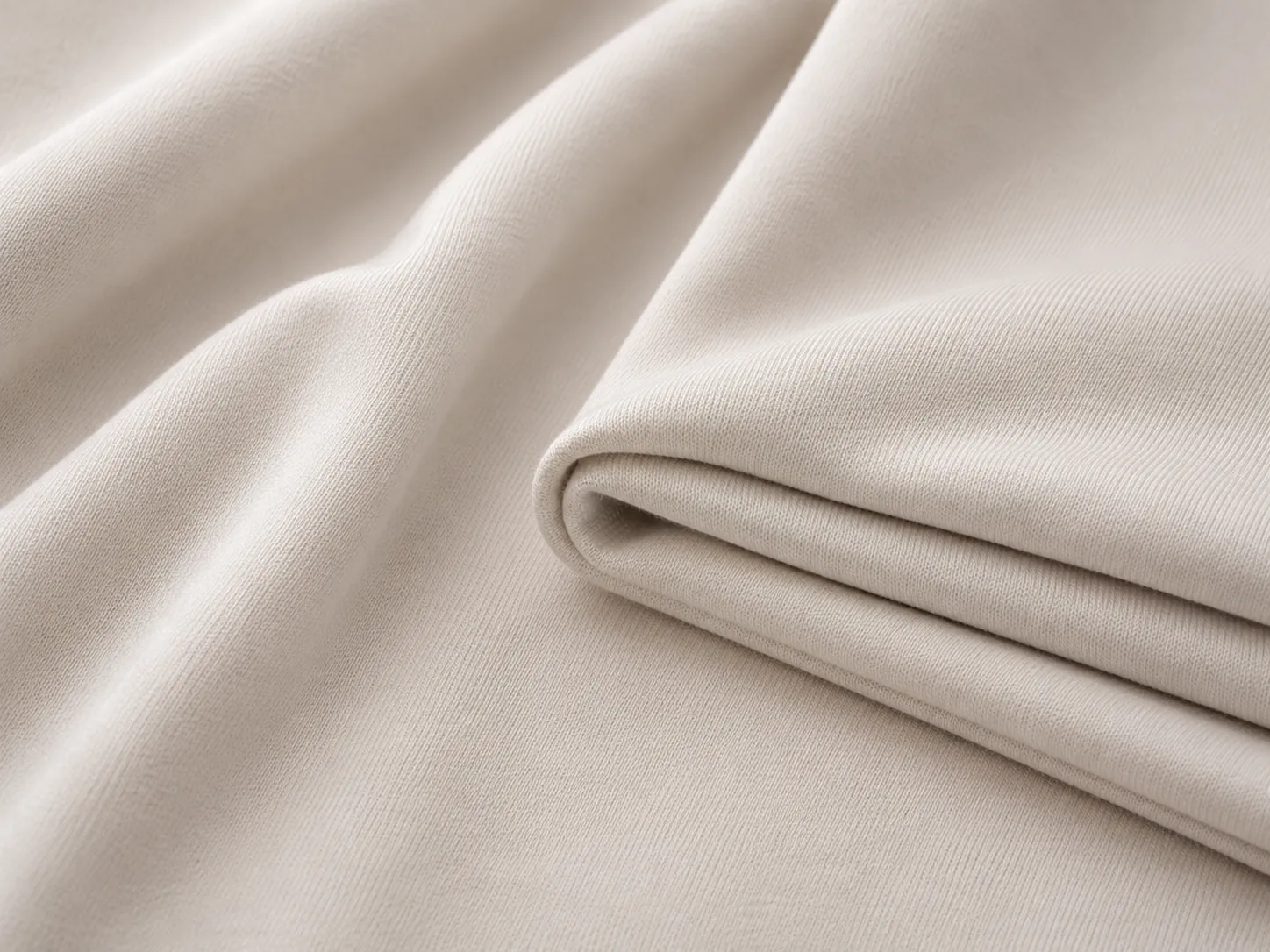
In underwear and babywear, the fabric is in direct and prolonged contact with the body. For this reason the selection criteria differ from outerwear: surface softness, moisture management, seams that do not cause irritation and chemical safety certificates rise to the top priority. Aesthetics and cost are built on top of these thresholds. Below we address the decisions purchasing and product development teams frequently face in a question-and-answer format.
Which constructions stand out in underwear and babywear fabric?
Single jersey offers sufficient coverage and lightness even at low GSM, which makes it the base fabric of the classic underwear and baby bodysuit/sleepsuit group. As seen in the single jersey and interlock comparison, interlock, thanks to its double-plate structure, presents both faces flat and fuller; this is preferred in bodysuits and pyjamas that call for opacity that reduces skin show-through and a more stable handle.
Rib wraps the body with its width/length stretch and is standard on neck, sleeve and leg binding; it is also used for ribbed bodysuits and vests knitted entirely from rib. In the rib and 2x2 rib differences guide we discuss that, because 2x2 rib gives a more pronounced texture, the flatter and gentler surface of rib is generally preferred in underwear.
Should you choose combed cotton, modal or a blend?
Combing is the process of carding the fibre to remove short fibres; this makes the yarn more even, less prone to fluffing and softer against the skin. This is the main reason combed yarn is preferred over carded yarn in underwear and especially baby products. Combed single jersey is the reference fabric of this segment in terms of both handle and durability.
Cellulose-based modal and TENCEL™ (lyocell), with their low coefficient of friction and soft surfaces, provide a more fluid, cool and silky handle when blended with cotton. Cotton-modal blends are frequently seen in premium underwear. Since dimensional behaviour can change as handle softness increases, in blended fabrics it is important to set up finishing steps such as sanforising and compacting correctly.
As we noted in the elastane and knitting relationship, in underwear elastane is generally used in a limited proportion: enough for adequate recovery and form, but at a level that does not compromise breathability and skin comfort. In baby products the elastane proportion is mostly kept even lower or used only in certain areas (waist, leg openings).
| Product | Recommended fabric | Typical fibre composition | Certification priority |
|---|---|---|---|
| Baby bodysuit / sleepsuit | Combed single jersey | 100% cotton (organic preferred) | OEKO-TEX® Class I (baby) + GOTS |
| Baby pyjamas / romper | Combed interlock | 100% cotton or cotton-modal | OEKO-TEX® Class I + GOTS |
| Adult vest / briefs | Combed single jersey / rib | 95% cotton / 5% elastane | OEKO-TEX® Class II + GOTS for organic |
| Premium underwear (bralette, set) | Cotton-modal single jersey | 50–60% cotton / remainder modal (+little elastane) | OEKO-TEX® + certification for cellulose origin |
| Pyjamas / loungewear | Interlock / 2-thread | Cotton or cotton-modal | OEKO-TEX® Class II |
| Thermal / ribbed underwear | Rib | Cotton / cotton-elastane | OEKO-TEX® Class II |
The composition and certification pairings in the table are guidance based on industry practice; the final recipe is finalised according to the target market, brand positioning and test protocol.
What should the GSM of baby fabric be?
As we detailed in the GSM guide, GSM is the weight of the fabric per square metre and directly affects both handle and coverage. In baby bodysuits and sleepsuits a very thin fabric may deform in the wash, while a very thick fabric can restrict movement and trap heat; therefore the medium-light band is preferred. In pyjamas and rompers the fullness of interlock is useful together with a slightly higher GSM.
| Product group | Knit | Typical GSM range (g/m²) | Standout property |
|---|---|---|---|
| Summer baby bodysuit | Single jersey | 120–150 | Lightness, breathability |
| All-season bodysuit / sleepsuit | Single jersey | 150–180 | Balance of coverage and durability |
| Baby pyjamas / romper | Interlock | 180–220 | Full, opaque, stable handle |
| Adult underwear | Single jersey / rib | 140–200 | Fine, stretchy, skin-friendly |
| Loungewear / pyjamas | Interlock / 2-thread | 200–280 | Warm handle, home comfort |
The ranges given are typical industry norms; GSM tolerance and dimensional stability targets are technical parameters to be agreed before production on an order-by-order basis.
Which finishing steps are decisive for a skin-friendly handle?
As we explained in our dyeing and printing process guide, the final handle and performance of a fabric are shaped not only by fibre selection but also by the finishing recipe. In underwear and babywear, the choice of softener finish is a critical decision: while improving the handle it must not compromise skin safety and must not exceed certification thresholds. For this reason the chemicals used must comply with OEKO-TEX® STANDARD 100 and the relevant restricted substance lists.
In baby products, hydrophilic (moisture-wicking) finishes may be preferred to reduce the sensation of dampness on skin contact; at the same time, sanforising and compacting for dimensional stability limit measurement shifts after washing. Control of defects such as spirality (knit twisting) is particularly important in single-faced single jersey bodysuits; otherwise the seam line twists around the body, spoiling both aesthetics and comfort.
On the colour side, in products that touch the skin, colour fastness and ΔE performance is directly related to safety. Perspiration, saliva and rubbing fastnesses (especially saliva/perspiration fastness in babies) must be high; the transfer of dye to the skin (crocking) must be kept low. At KARCEM, colour matching is carried out in a lab-dip → approval → production flow with a target of ΔE<1; this meets both within-collection tone consistency and the post-printing safety expectation together.
Which certifications are required for babywear and underwear?
OEKO-TEX® STANDARD 100 monitors the limit values of harmful substances in textiles and classifies products according to skin-contact intensity. Baby and small children's products are assessed in the class where the strictest thresholds apply, owing to direct and prolonged skin contact and the risk of being put in the mouth. For this reason, in baby collections this certificate is effectively an entry requirement in most markets.
In products carrying an organic cotton claim, GOTS, which documents content and supply-chain integrity, comes into play. As we addressed in the GOTS, RCS and carbon guide, GOTS covers not only fibre origin but also dyeing/finishing chemicals, social criteria and chain integrity (custody). This makes it a strong certificate that carries both a safety and a sustainability claim together, especially in the baby segment. If recycled content is used, the content is verified with GRS or RCS.
KARCEM combines its in-house knitting production with commission dyeing/printing/finishing coordinated through a vetted, geographically close contract network under one point of contact, and works within the scope of GOTS, OCS, GRS, RCS, BCI and UPMADE. This structure enables underwear and babywear customers to establish single-point traceability over both fibre origin and process chemicals, and to carry certification claims across the entire production chain.
| Claim / need | Relevant certification | What it documents |
|---|---|---|
| Skin-contact safety (general) | OEKO-TEX® STANDARD 100 | Harmful substance limit values, class-based |
| Baby/child safety | OEKO-TEX® Class I | Strictest thresholds, mouth/prolonged contact risk |
| Organic cotton content | GOTS | Fibre origin + chemical + social + chain integrity |
| Uncertified organic content declaration | OCS | Traceability of the organic content proportion |
| Recycled content | GRS / RCS | Recycled content and chain verification |
Are seams and construction as important as the fabric?
The softness of the fabric alone is not enough; a seam line running across the skin or a hard wash label can cause irritation even in the finest combed single jersey. For this reason, flatlock seams and printed (non-woven) labels are common in baby bodysuits, while seamless or laser-cut construction is common in premium underwear. In binding and cuffs, the soft, stretchy and recovering structure of rib supports both comfort and product life.
Construction decisions also affect fabric selection: tube or circular knitting parameters for seamless machines, and a compatible rib width and GSM for bound products, must be planned in advance. Evaluating fabric, construction and certification requirements together at the product development stage shortens the rounds of sampling.
What should the decision order be in product development?
Putting the certification requirement first prevents the cost of later recipe changes and re-testing, because the dye and finish chemicals to be used are directly tied to the certification threshold. Fibre and knit selection determine handle and coverage; GSM and finishing determine the final comfort and dimensional behaviour. Our sourcing and supply guide and our MOQ, sampling and delivery process page address how these decisions fit into the procurement schedule.
For a broader context, you can look at the product-based fabric selection guide and the knitted fabric guide that explains the fundamental logic of knitted fabrics. In product groups neighbouring underwear, our t-shirt, activewear/leggings and polo fabric guides are complementary resources.
Underwear & baby fabric we manufacture — composition and GSM
As a underwear & baby fabric manufacturer and supplier in Turkey, KARCEM knits greige fabric on its own circular machines and coordinates dyeing, printing and finishing across an audited contract network. Typical constructions and weight ranges we produce:
| Composition | Weight (g/m²) | Width | Typical use |
|---|---|---|---|
| Fine combed cotton single jersey | 120–180 | Tubular | Underwear, baby bodysuits |
| Cotton / elastane rib | 180–220 | Tubular | Underwear waistbands, fitted |
| Modal / cotton jersey | 120–160 | Tubular | Premium soft underwear |
| Interlock (baby) | 180–220 | Tubular | Baby pyjamas and rompers |
Capacity, MOQ and lead time
Group knitting capacity is around 450 tonnes per month, so we serve both low-MOQ development runs and high-volume repeat programmes. MOQ is not a single figure — it is defined per colour, weight and process together, so a realistic minimum becomes clear once we see your combination. Lead time depends on quantity, finish and dye-lot planning and is confirmed with your quote. See our MOQ, sampling and lead-time and lab-dip approval pages, then request a underwear & baby fabric quote with your composition, GSM and quantity.
Certifications and compliance
We work with GOTS, OCS, GRS and RCS certified processes and BCI cotton, and can supply OEKO-TEX STANDARD 100-conformant, skin-safe fabrics for babywear and underwear. Colour is targeted at ΔE<1 versus the approved lab dip, with fastness and dimensional-stability testing available on request. See our certificates and colour-fastness pages for detail.
OEM, private-label and export
KARCEM supplies underwear & baby fabric as an OEM and private-label knit fabric manufacturer: greige-to-finished production under your specification, ready for your own cut-and-sew or garment supplier. We export knit fabric from Turkey to the EU, UK, Middle East, North America and Russia on EXW, FOB or CIF terms. For programme pricing per kilogram, share your annual volume and target constructions.
Frequently asked questions
What is the minimum order quantity (MOQ) for underwear and baby fabric?
MOQ is flexible and set per colour and construction. We handle development lots and high-volume repeat orders; share your composition, GSM and quantity and we confirm the minimum with the quote.
Do you supply OEKO-TEX certified fabric for babywear?
Yes. We can supply OEKO-TEX STANDARD 100-conformant, skin-safe fabrics for babywear and underwear, with the certificates your market requires.
What does modal add for underwear?
Modal adds a soft, silky hand and good moisture handling; blended with combed cotton it makes a premium next-to-skin underwear fabric that stays soft after washing.
Do you export underwear and baby fabric?
Yes. We export these fabrics from Turkey to the EU, UK, Middle East, North America and Russia on EXW, FOB or CIF terms.
Which fabric and weight range is recommended for baby bodysuits and envelope tops?
For baby bodysuits and envelope tops, combed single jersey is recommended; its single-knit, fine and soft structure provides sufficient coverage even at low weights. Typical ranges are 120-150 g/m² for summer bodysuits and 150-180 g/m² for all-season bodysuits/envelope tops. Very thin fabric deforms in the wash and very thick fabric restricts movement, so a medium-light band is preferred. On the fibre side, 100% cotton is used, preferably organic.
Why interlock for baby pyjamas and rompers, and which weight is chosen?
For baby pyjamas and rompers, combed interlock is preferred; its double-knit construction gives both faces a smooth, full appearance, with opacity that reduces show-through and delivers a more stable hand. The typical weight is in the 180-220 g/m² range. The fibre is 100% cotton or a cotton-modal blend. The fullness of interlock, together with a slightly higher weight, is practical for pyjamas and rompers.
Should underwear use combed or carded yarn, and what does modal add?
For underwear and especially for babywear, combed yarn is preferred over carded. Combing is the process of removing short fibres by combing the fibre; it makes the yarn smoother, less prone to pilling and softer against the skin. For a silkier hand, cellulose-based modal or TENCEL™ is added to the cotton; with its low coefficient of friction it delivers a more fluid, cool and silky hand. Cotton-modal blends are common in premium underwear.
Which certifications are required for baby and underwear products?
For skin-contact products the baseline document is OEKO-TEX STANDARD 100; baby and toddler products fall under the strictest class, Class I, due to the risk of direct/prolonged contact and mouthing, and this is effectively an entry requirement in most markets. An organic cotton claim requires GOTS, while recycled content requires GRS or RCS. The certificate type is selected according to the type of claim.
Which finishing steps are decisive for a skin-friendly hand and colour safety?
A soft hand is largely determined in finishing: combed yarn smooths the surface, a softener finish improves the hand, sanforizing/compacting controls wash shrinkage, and a hydrophilic finish increases moisture absorption. The chemicals must comply with OEKO-TEX STANDARD 100. On the colour side, perspiration, saliva and rubbing fastness are kept high and crocking low; at KARCEM colour matching is run through a lab-dip → approval → production flow with a ΔE<1 target.
Beyond the fabric, what should be watched in construction to prevent irritation?
In skin-contact underwear and babywear, irritation often comes not from the fabric but from the seams and the label; a seam line running across the skin or a stiff care label can cause irritation even on the highest-quality combed single jersey. Flatlock seams and a printed non-woven label are common in baby bodysuits, while seamless or laser-cut construction is common in premium underwear. For bindings and cuffs, the soft, elastic and recovering structure of rib is preferred.