
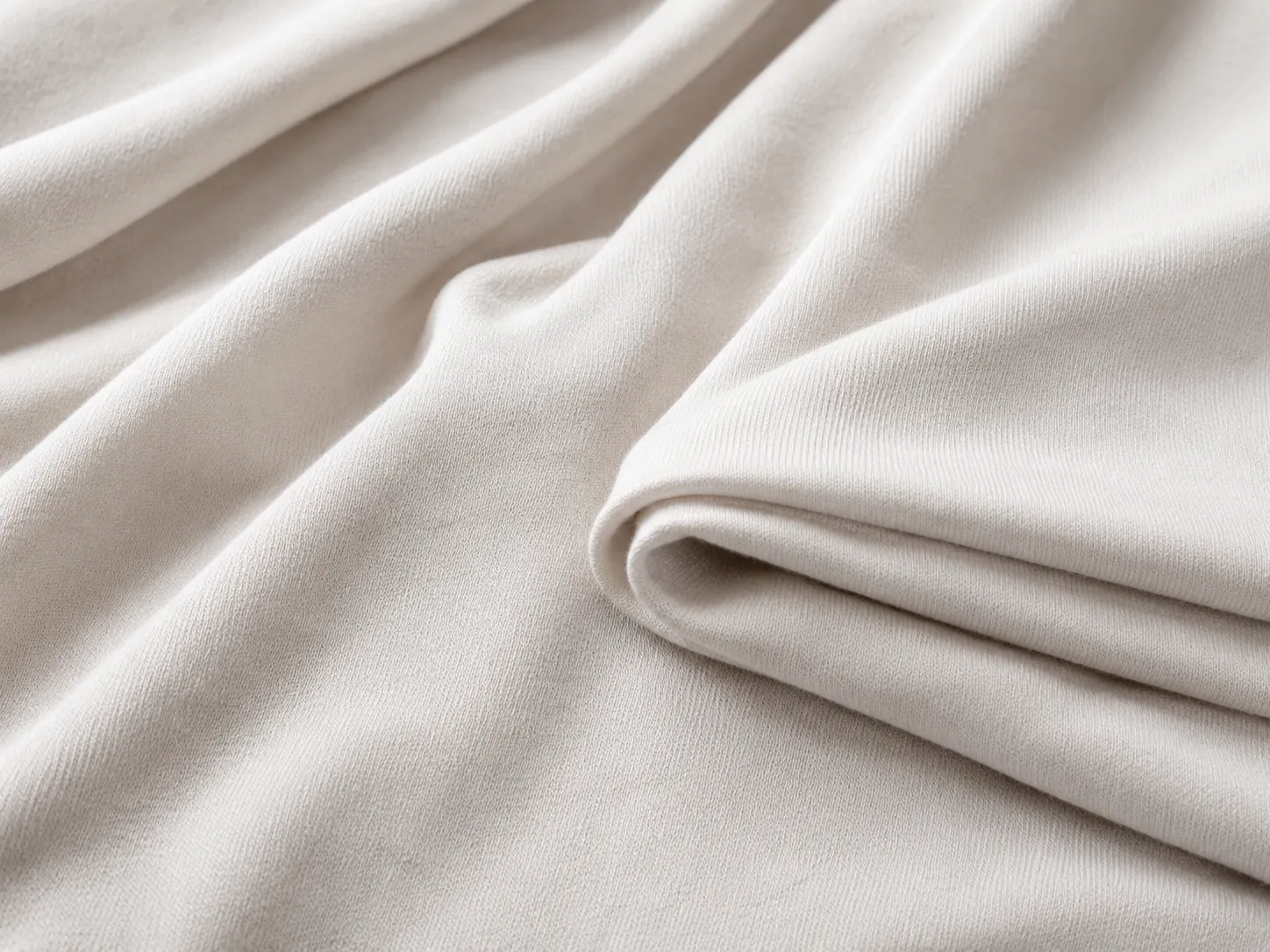
Single jersey (known in Türkiye as süprem) is the most basic and most common single-layer knit fabric, knitted on a circular knitting machine with a single needle bed. One face consists of straight vertical loop wales (the technical face), while the other consists of horizontal reverse loops (the technical back); this two-sided structure is the defining characteristic of single jersey. KARCEM knits single jersey in its greige state at the knitting department of its Esenyurt facility and completes the dyeing and finishing stages within an audited subcontractor network.
What is single jersey and how is it knitted?
Single jersey is produced when each needle on the machine forms loops in the same direction in turn. Because a single needle bed (single plate) is used, the two faces of the fabric differ from each other: the front face shows upright straight loops (V-shaped), while the back face shows horizontal reverse loops (half-moon shaped). This structure is its fundamental difference from double-bed fabrics such as interlock or rib.
The single-layer structure makes single jersey thinner, lighter and more elastic than other knits. The same structure gives the fabric a characteristic fluidity and a soft hand; however, it also brings behaviour such as the spontaneous curling of uncut edges.
Properties of single jersey fabric
Single jersey stands out for its lightness and softness. Because it is single-layer, it holds fewer yarns per unit area; this makes it a breathable, cool and drapey fabric. Cotton single jersey absorbs perspiration and leaves a dry feel on the skin, providing high comfort in everyday wear.
- Lightness: Thanks to the single-layer structure, it is one of the lightest knit fabrics.
- Fluid drape: It gives a hand that follows the body's lines softly, flowing rather than sagging.
- Breathability: Its open knit structure supports air circulation, making it ideal for summer products.
- Elasticity: Noticeable stretch in the widthwise direction; it offers comfortable wear even when no spandex is added.
- Cost efficiency: It is an economical option thanks to low yarn consumption and fast knitting.
Single jersey weight range and measurement
The typical weight range of single jersey is between 120-180 g/m². Lighter single jerseys below this range are preferred for linings and lightweight summer tops, while heavier ones are preferred for fuller T-shirts and under-sweat products. Weight directly determines the fabric's mass and therefore its hand.
Weight is measured in grams per square metre (g/m²) by cutting a disc of a specific diameter from the fabric and weighing it. For the measurement method and the effect of weight on hand, you can refer to our fabric weight (GSM) guide page.
| Weight (g/m²) | Hand | Typical use |
|---|---|---|
| 120-140 | Thin, very fluid | Lining, lightweight dress, summer blouse |
| 140-160 | Standard, balanced | Everyday T-shirt, basic tops |
| 160-180 | Full, more opaque | Quality T-shirt, premium basic |
| 180+ | Heavy single jersey | Oversize T-shirt, outer-layer lining |
Single jersey with spandex (elastane single jersey)
While standard single jersey is knitted only from cotton or a cotton-polyester blend, elastane yarn is added to the knit for products that require stretch and recovery. Spandex single jersey, which generally contains 3-8% elastane, gains higher stretch and the ability to return to its original form both widthwise and lengthwise.
Elastane single jersey is frequently used in body-hugging T-shirts, bodysuits, leggings underlayers and underwear products. For details on integrating elastane into the knit structure, ratio selection and finishing effects, you can review our knit fabrics containing lycra/elastane page.
Uses of single jersey fabric
Single jersey is the backbone of ready-to-wear and appears in many everyday products you touch. Its light, breathable and cost-effective structure makes it the base fabric for a very wide range of products.
- T-shirt: The most common use; the standard for basic, printed and promotional T-shirts.
- Underwear: Preferred in the vest, bodysuit and undershirt group for its soft touch.
- Dress and blouse: Its drapey hand is ideal for flowing cuts.
- Lining: Thin single jerseys are used as inner lining in jackets and knit outerwear.
- Baby and children's wear: Suited to delicate skin with its light, breathable structure.
Why does edge curling occur and how is it managed?
The best-known behaviour of single jersey is the spontaneous curling of its cut edges. The reason is the structural asymmetry between the two faces of the fabric: because the yarn tensions of the front and back loops differ, the free edge tends to curl towards the back face widthwise and towards the front face lengthwise.
This behaviour is not a defect but a natural consequence of the single jersey structure, and it can be managed in production. Proper finishing and setting processes reduce the tendency to curl; at the garment-making stage, overlock and closed-seam techniques fix the edge. Softener applications and controlled drying also help to balance the curling.
Single jersey or interlock?
Single jersey and interlock are the two basic structures most often compared when choosing a knit fabric. Single jersey is knitted on a single-bed machine, its two faces differ, and it is lighter and more drapey; its edge curls. Interlock, on the other hand, is knitted on a double-bed machine, both faces are flat and identical, and it is thicker, fuller and dimensionally more stable; its edge does not curl.
Which one is right depends on the product: single jersey stands out for a fluid, light and economical T-shirt; interlock for a full, opaque and more durable feel. For a detailed comparison of the two fabrics' yarn consumption, weight and use differences, take a look at our single jersey vs interlock comparison page.
Single jersey fabric we manufacture — composition and GSM
As a single jersey fabric manufacturer and supplier in Turkey, KARCEM knits greige single jersey on its own circular machines and coordinates dyeing, printing and finishing across an audited contract network. Typical constructions and weight ranges we produce:
| Composition | Weight (g/m²) | Width | Typical use |
|---|---|---|---|
| 100% combed cotton | 120–200 | Tubular / open width | T-shirts, basics, promo tees |
| Cotton / elastane (95/5) | 160–220 | Tubular | Fitted tees, bodysuits, underwear |
| CVC / poly-cotton | 140–200 | Tubular / open width | Workwear, high-wash tees |
| Polyester / recycled PES | 130–180 | Open width | Sportswear, sublimation print |
| Modal / viscose blends | 130–170 | Tubular | Premium-drape fashion tees |
Common weights map to end use as follows: 140–160 g/m² for everyday T-shirts, 160–180 g/m² for premium basics, and 180+ g/m² for oversize and heavyweight tees. We develop custom blends and gauges against your specification.
Capacity, MOQ and lead time
Our knitting capacity is around 450 tonnes per month, so we serve both low-MOQ development runs and high-volume repeat programmes. MOQ is not a single figure — it is defined per colour, weight and process together, so a realistic minimum becomes clear once we see your combination. Lead time depends on quantity, finish and dye-lot planning and is confirmed with your quote. See our MOQ, sampling and lead-time and lab-dip approval pages, then request a single jersey quote with your composition, GSM and quantity.
Certifications and compliance
We work with GOTS, OCS, GRS and RCS certified processes and BCI cotton, and can supply organic-cotton and recycled-polyester single jersey against valid transaction certificates. Colour is targeted at ΔE<1 versus the approved lab dip, with fastness and dimensional-stability testing available on request. See our certificates and colour-fastness pages for detail.
OEM, private-label and export
KARCEM supplies single jersey as an OEM and private-label knit fabric manufacturer: greige-to-finished production under your specification, ready for your own cut-and-sew or garment supplier. We export knit fabric from Turkey to the EU, UK, Middle East, North America and Russia on EXW, FOB or CIF terms. For programme pricing per kilogram, share your annual volume and target constructions.
Frequently asked questions
Are single jersey fabric and süprem the same thing?
Yes. Süprem is the Turkish industry name for single jersey fabric. Both refer to the same basic knit structure, knitted on a single needle bed with a flat face on one side and a looped reverse on the other.
Does single jersey fabric stretch?
Single jersey stretches noticeably in the widthwise direction; the knit structure provides this elasticity naturally. If a higher, more recoverable stretch is desired, elastane is added to the knit to produce spandex single jersey.
Does single jersey fabric shrink?
Single jerseys that have not been properly finished and set may show shrinkage in the first washes. With controlled finishing, setting and appropriate weight selection, the shrinkage margin is kept within acceptable limits; this is why pre-production shrinkage testing is important.
What should the weight of single jersey fabric be?
It varies according to the intended use. The 120-140 g/m² range is preferred for lightweight summer products and linings, 140-160 g/m² for standard T-shirts, and 160-180 g/m² for full and premium T-shirts.
Is single jersey fabric suitable for T-shirts?
Single jersey is the most common and most suitable fabric for T-shirt production. Its lightness, breathability and affordable cost make it the standard choice for basic, printed and promotional T-shirts.
What is the minimum order quantity (MOQ) for single jersey?
MOQ is flexible and set per colour and construction. We accommodate smaller development lots as well as high-volume repeat orders; share your composition, GSM and quantity and we confirm the exact minimum with the quote.
Do you export single jersey fabric to Europe?
Yes. We export single jersey and other knit fabrics from Turkey to the EU, UK, Middle East, North America and Russia, on EXW, FOB or CIF terms with the certificates your market requires.
Can you match a Pantone or lab-dip colour?
Yes. We work to your Pantone reference or physical standard and return a lab dip for your approval, targeting ΔE<1 against the standard before bulk dyeing.
Do you offer organic or recycled single jersey?
Yes. We can produce single jersey in GOTS/OCS organic cotton and GRS/RCS recycled polyester, supplied with valid transaction certificates.
With KARCEM
With the right yarn, weight and finishing choices, single jersey becomes both an economical and highly comfortable fabric. As a knitted fabric manufacturer, KARCEM customises single jersey by weight, width and blend according to your project requirements. You can review all our knit fabric varieties, including single jersey.
One contact, end to end: knitting on our own machines · dyeing, printing and finishing at supervised contract partners · lot quality control · ΔE<1 colour verification · certificates and TCs · sampling · shipment. See the production process →
Products made with this fabric: T-Shirt Fabric · Underwear & Baby Clothing Fabric
Certification and documents: Certifications · How to Verify a Textile Certificate