
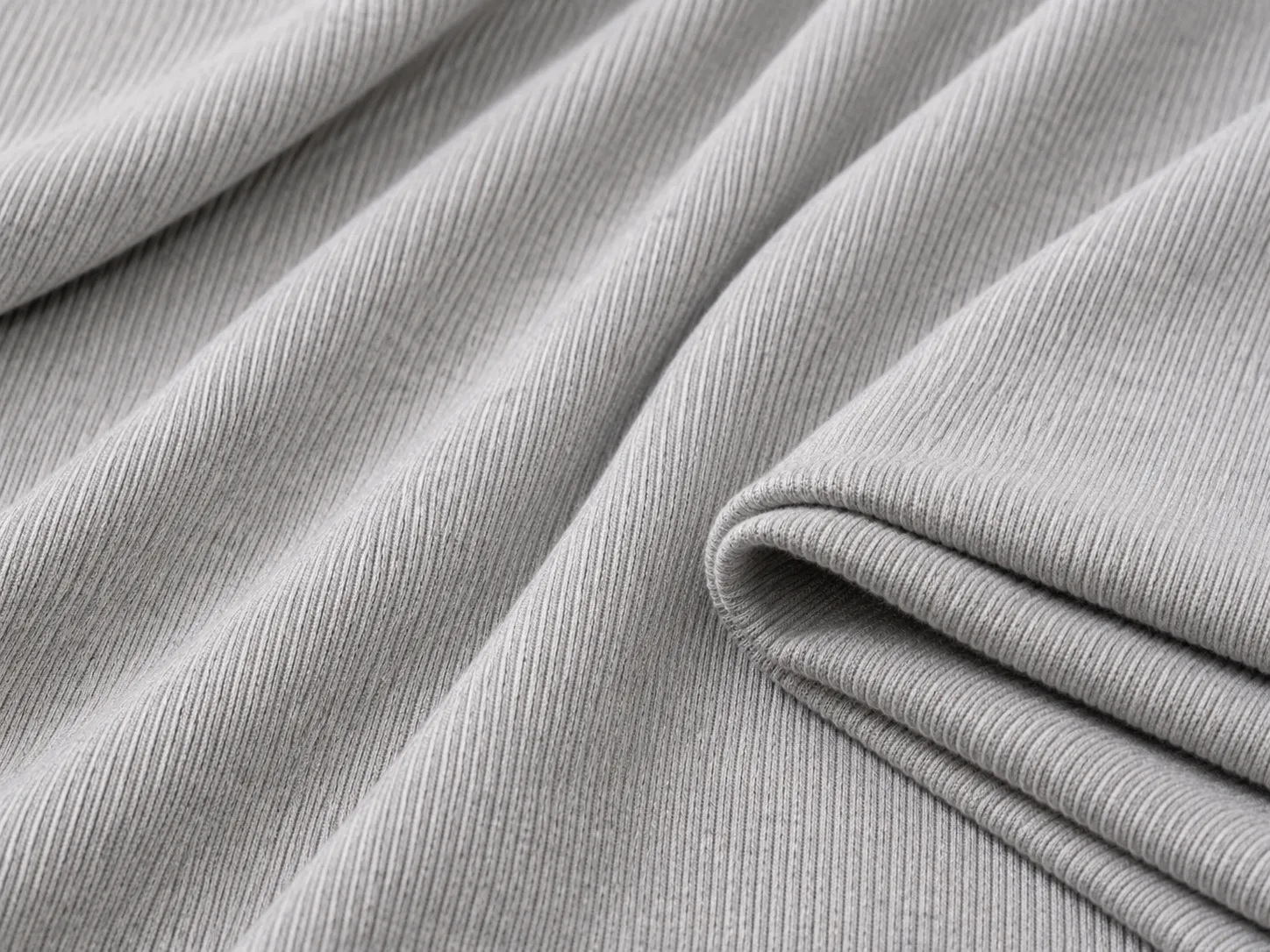
Rib knit (ribana) is an elastic knitted fabric knitted with the front and back needle rows working in an opposing (rib) arrangement, showing vertical loop columns (ribs) on both faces and recovering when stretched crosswise. Thanks to this structure, rib knit is known for its ability to stretch and return to its original shape, and it is one of the most critical finishing materials in knitwear. KARCEM produces rib knit at its Esenyurt facility for functional details such as collars, cuffs and waistbands, as well as for stand-alone garments.
What is rib knit and how is it knitted?
Rib knit is produced on double-bed (rib) circular knitting machines through the opposing action of the cylinder and dial needles. While loops form in a single direction in plain-knit (single jersey) construction, in rib knit the loops are alternately set to the front and back. This alternating placement gives a flat appearance on both faces of the fabric and creates an "accordion"-like stretch in the crosswise direction.
The rib structure has two fundamental consequences: the fabric stretches strongly crosswise and returns to its original dimension when released; and, unlike single jersey fabrics, its edges do not curl. These two properties make rib knit ideal for trim, collar and cuff applications. You can explore the related plain-knit structure in the single jersey vs. interlock comparison; for the glossary definition, see the ribana entry.
The difference between 1×1 and 2×2 rib knit
Rib knit is named according to the needle placement ratio. 1×1 rib knit is knitted with one knit and one purl loop alternating; it gives a fine, dense and balanced structure. 2×2 rib knit, on the other hand, follows a two-knit, two-purl arrangement; it offers more pronounced, wider rib lines and generally higher crosswise stretch.
1×1 rib knit is preferred for fine collars and cuffs and delicate t-shirt finishes, while 2×2 rib knit stands out in tracksuit, sweater and sweatshirt waist/cuff ribbing and in decorative rib details. As the ratio increases, the fabric's elastic character and visual depth grow.
| Property | 1×1 Rib Knit | 2×2 Rib Knit |
|---|---|---|
| Rib appearance | Fine, dense line | Wide, pronounced line |
| Crosswise stretch | High | Very high |
| Typical use | T-shirt collar/cuff | Sweatshirt/tracksuit ribbing |
| Visual character | Plain, classic | Sporty, decorative |
The relationship between rib knit and kashkorse
Rib knit and kashkorse are often confused because both are rib-based. Kashkorse is a variant that is mostly based on 2×2 rib, thicker and with a more pronounced line, and is generally used in making stand-alone garments (bodysuits, vests, dresses). Rib knit, on the other hand, is positioned across a broader range, both as a finishing material and as a garment fabric. We have detailed the distinctions between the two structures on the kashkorse vs. rib knit differences page; for the term definition, take a look at the kashkorse glossary entry.
Properties of rib knit fabric
Three properties define the technical identity of rib knit:
- Crosswise stretch: Thanks to the rib structure, the fabric stretches noticeably in the crosswise direction; this is critical for ease of putting on and taking off and for fit to the body.
- Recovery: The stretched fabric returns to its original dimension when tension is removed. High recovery means collars do not sag and cuffs do not loosen.
- Shape retention: A dense and balanced rib structure provides dimensional stability through repeated washing; non-curling edges also yield clean sewing.
These properties depend on raw material quality, machine fineness (gauge) and the discipline of the finishing process. We have summarized the effect of the finishing stage on fabric behavior under the finishing term.
Typical GSM range and measurement
Rib knit weight varies over a wide range depending on the intended use. Fine collar/cuff rib knits are generally in the 180–240 g/m² band, garment rib knits in the 220–320 g/m² range, and thick 2×2 ribbing rib knits can be 320 g/m² and above.
| Application | Typical weight (g/m²) | Structure |
|---|---|---|
| Fine collar/cuff | 180–240 | 1×1 |
| Garment rib knit (bodysuit, dress) | 220–320 | 1×1 / 2×2 |
| Sweatshirt ribbing | 320–420 | 2×2 |
Weight is the fabric's weight per square meter, and accurate measurement is essential for batch consistency. For measurement methods and choosing the right weight, review the weight (GSM) guide; for the definition, see the weight term.
Spandex rib knit and elastane content
Rib knit is elastic by nature; however, when elastane (spandex) is added into the yarn, its stretch and recovery increase markedly. Spandex rib knit allows collars and cuffs to retain their shape longer and keeps waist and cuff ribbing from loosening. The typical elastane ratio is between 3–8% and is adjusted according to the application.
The behavior of elastane-containing knits requires special care in dyeing and finishing; for this reason, the elastane ratio and process parameters must be controlled batch by batch. We went deeper into the subject on the spandex/elastane knits page.
Where is rib knit used?
Rib knit has two main groups of use:
- Finishing material: T-shirt, sweatshirt and polo collars; sleeve cuffs; tracksuit waist and hem ribbing; jacket and cardigan edge trims.
- Stand-alone garment fabric: Bodysuits, body-hugging dresses, kashkorse-like fitted tops, sweater details and decorative rib panels.
As a finishing material, rib knit is selected in harmony with the garment's main fabric in color and weight; this harmony is important both for visual integrity and for uniform washing behavior. You can see KARCEM's entire knitted fabric family on the fabrics page.
Care and washing
To preserve the elastic character of rib knit, washing at 30 °C, inside out and at a low spin speed is recommended. High temperature and harsh spinning can fatigue the elastane fibers, especially in spandex rib knit, weakening recovery. Drying by hanging instead of using a dryer prolongs shape retention. If ironing is needed, it should be done at medium temperature and with steam.
Rib knit fabric we manufacture — composition and GSM
As a rib knit fabric manufacturer and supplier in Turkey, KARCEM knits greige fabric on its own circular machines and coordinates dyeing, printing and finishing across an audited contract network. Typical constructions and weight ranges we produce:
| Composition | Weight (g/m²) | Width | Typical use |
|---|---|---|---|
| 1×1 cotton rib | 180–240 | Tubular | Cuffs, collars, waistbands |
| 2×2 rib (kaşkorse) | 220–320 | Tubular | Bodysuits, fitted tops |
| Cotton / elastane (lycra) rib | 200–280 | Tubular | Stretch cuffs, fitted garments |
| Polyester rib | 180–240 | Tubular | Trims and sportswear ribbing |
Capacity, MOQ and lead time
Our knitting capacity is around 450 tonnes per month, so we serve both low-MOQ development runs and high-volume repeat programmes. MOQ is not a single figure — it is defined per colour, weight and process together, so a realistic minimum becomes clear once we see your combination. Lead time depends on quantity, finish and dye-lot planning and is confirmed with your quote. See our MOQ, sampling and lead-time and lab-dip approval pages, then request a rib knit fabric quote with your composition, GSM and quantity.
Certifications and compliance
We work with GOTS, OCS, GRS and RCS certified processes and BCI cotton. Colour is targeted at ΔE<1 versus the approved lab dip, with fastness and dimensional-stability testing available on request. See our certificates and colour-fastness pages for detail.
OEM, private-label and export
KARCEM supplies rib knit fabric as an OEM and private-label knit fabric manufacturer: greige-to-finished production under your specification, ready for your own cut-and-sew or garment supplier. We export knit fabric from Turkey to the EU, UK, Middle East, North America and Russia on EXW, FOB or CIF terms. For programme pricing per kilogram, share your annual volume and target constructions.
Frequently asked questions
What is the minimum order quantity (MOQ) for rib knit fabric?
MOQ is flexible and set per colour and construction. We accommodate development lots and high-volume repeat orders; share your rib type, composition, GSM and quantity and we confirm the minimum with the quote.
Do you supply lycra (elastane) rib?
Yes. We produce cotton/elastane rib in 1×1 and 2×2 for stretch cuffs, waistbands and fitted garments, with the elastane dosage tuned to your recovery target.
What is the difference between 1×1 and 2×2 rib?
1×1 rib alternates one face and one reverse wale for a fine elastic trim; 2×2 (kaşkorse) uses two-and-two wales for a deeper, bulkier stretch used in bodysuits and fitted tops.
Do you export rib knit fabric?
Yes. We export rib and other knit fabrics from Turkey to the EU, UK, Middle East, North America and Russia on EXW, FOB or CIF terms.
What is the difference between rib knit and single jersey?
Single jersey is a single-faced plain knit; its edge curls and its stretch is limited. Rib knit, on the other hand, is knitted with an opposing rib structure; it is far more elastic crosswise, recovers itself and does not curl at the edge. That is why rib knit is preferred as a finishing material.
Should I choose 1×1 or 2×2 rib knit?
For fine, classic collars and cuffs, 1×1 is suitable; for sporty, pronounced-line and more elastic ribbing (sweatshirt, tracksuit), 2×2 rib knit is the right choice. The selection is made according to the weight of the garment's main fabric and the desired visual character.
Why does a rib knit collar sag over time?
Sagging mostly results from low recovery capacity. With quality raw material, the right elastane ratio and disciplined finishing, this problem is prevented. Spandex rib knit markedly extends shape retention.
What weight should rib knit be?
For fine collars/cuffs 180–240 g/m², for garments 220–320 g/m², and for thick ribbing above 320 g/m² are typical ranges. The right weight is determined according to harmony with the main fabric and the intended use.
Does rib knit shrink?
Properly finished rib knit shows minimal shrinkage in the first wash. Dimensional stability is achieved with controlled finishing and sanforizing; each batch should be tested for batch-to-batch consistency.
With KARCEM
In choosing rib knit, what is critical is determining the rib ratio correctly, matching the weight to the main fabric, and ensuring batch-to-batch consistency in color and dimension. As a knitted fabric manufacturer, KARCEM takes on this control end to end.
One contact, end to end: knitting on our own machines · dyeing, printing and finishing at supervised contract partners · lot quality control · ΔE<1 colour verification · certificates and TCs · sampling · shipment. See the production process →
Certification and documents: Certifications · How to Verify a Textile Certificate