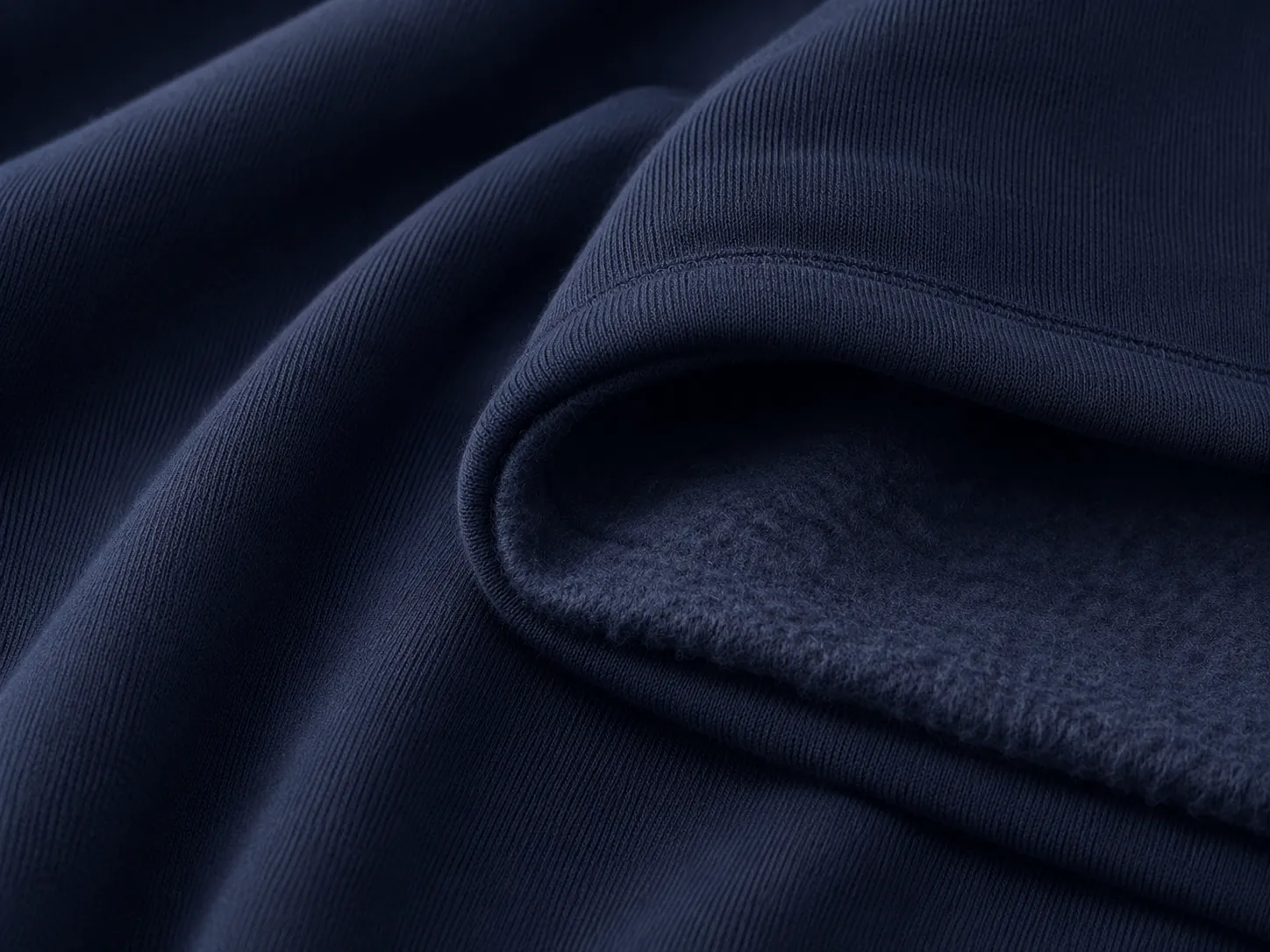
In three-thread fleece, a thicker backing yarn is fed into the inner face in addition to the ground and binding yarns. This yarn adds volume to the knit; it is then combed by wire-covered rollers on a brushing machine and turned into a raised pile. The still air trapped between the fibres gives the fabric its warmth retention. When the same knit is left unbrushed, it gives a fuller, looped inner face; this is the variant known in the trade as “unbrushed three-thread”. In the KARCEM catalogue, three-thread fleece is listed at cotton · polyester, 280–420 g/m².
What products is three-thread fleece used for?
Winter hoodies and sweatshirts, heavy tracksuits and outdoor sweat products are the main territory of three-thread fleece. Because the weight band is wide, the same fabric family can be adapted both to a seasonal sweatshirt and to a heavy winter product. For a decision taken together with fit and season, see the sweatshirt and hoodie fabric page.
How do you choose within the weight band?
280–420 g/m² is not a single product but a range. Where you sit in the band is determined by hand, warmth and fit together:
| Band zone | Hand | Warmth | Typical product |
|---|---|---|---|
| Lower end | More fluid, light | Medium | Seasonal sweatshirt, close-to-body fit |
| Middle | Balanced, full-bodied | High | Classic winter hoodie |
| Upper end | Firm, structured | Very high | Heavy tracksuit, outdoor sweat, oversized fit |
If you need a lighter, more breathable sweat, two-thread fleece is the better starting point; if you need an insulation layer or lining, 100% polyester polar fleece is. For the structural difference between two-thread and three-thread, see the two-thread vs three-thread comparison.
What should a three-thread fleece specification include?
- Weight: because brushing and finishing change the fabric’s volume and dimensions, finished weight differs from greige weight; the target should be stated as finished weight.
- Inner face: brushed or unbrushed; if brushed, the required pile density and shearing.
- Composition: the cotton–polyester ratio and the type of backing yarn.
- Finish: whether an anti-pilling treatment is applied against pilling.
- Colour: because the raised inner face refracts light differently, both faces should be assessed on the approval sample.
- Cuffs and waistband: the need for rib matching the body.
Frequently asked questions
What does unbrushed three-thread mean?
It is three-thread with the backing yarn fed in but the inner face left unbrushed. Instead of pile, the inner face carries full loops; the fabric is less warm and cleaner-looking than the brushed variant. It is preferred for oversized and “structured” cuts.
Which is warmer, three-thread fleece or polar fleece?
Both are brushed, and warmth is determined by the air held by the inner face. The real difference lies in fibre and use: three-thread is a body fabric with a cotton hand and absorbs moisture thanks to its cotton content; polar fleece is 100% polyester, does not hold moisture and is mostly used as an insulation layer or lining.
Does a brushed inner face shed fibres in the wash?
Fibre ends left loose on the surface after brushing may shed some lint in the first washes. Shearing and correctly set brushing intensity reduce this; over-brushing, on the other hand, increases both shedding and loss of strength.
Does three-thread fleece shrink?
Knit fabrics containing cotton relax to some extent in the first wash, and three-thread is no exception. This shrinkage is taken out in production with a compacting or sanforizing step; writing the accepted tolerance into the specification makes the issue visible before delivery.
What determines the price of three-thread fleece?
Because three separate yarns are fed and the backing yarn is thick, yarn consumption in three-thread is higher than in two-thread, and the gap widens as weight increases. The number of brushing passes, shearing and anti-pilling finish are separate finishing items. The number of colours, batch size and yarn quality complete the price.
With KARCEM
Two things determine quality in three-thread fleece: brushing intensity staying constant from batch to batch, and weight staying on target after brushing. As a knit fabric manufacturer, KARCEM knits the greige fabric on its own machines and plans finishing around these two criteria.
One contact, end to end: knitting on our own machines · dyeing, printing and finishing at supervised contract partners · lot quality control · ΔE<1 colour verification · certificates and TCs · sampling · shipment. See the production process →
Products made with this fabric: Hoodie & Sweatshirt Fabric
Certification and documents: Certifications · How to Verify a Textile Certificate