
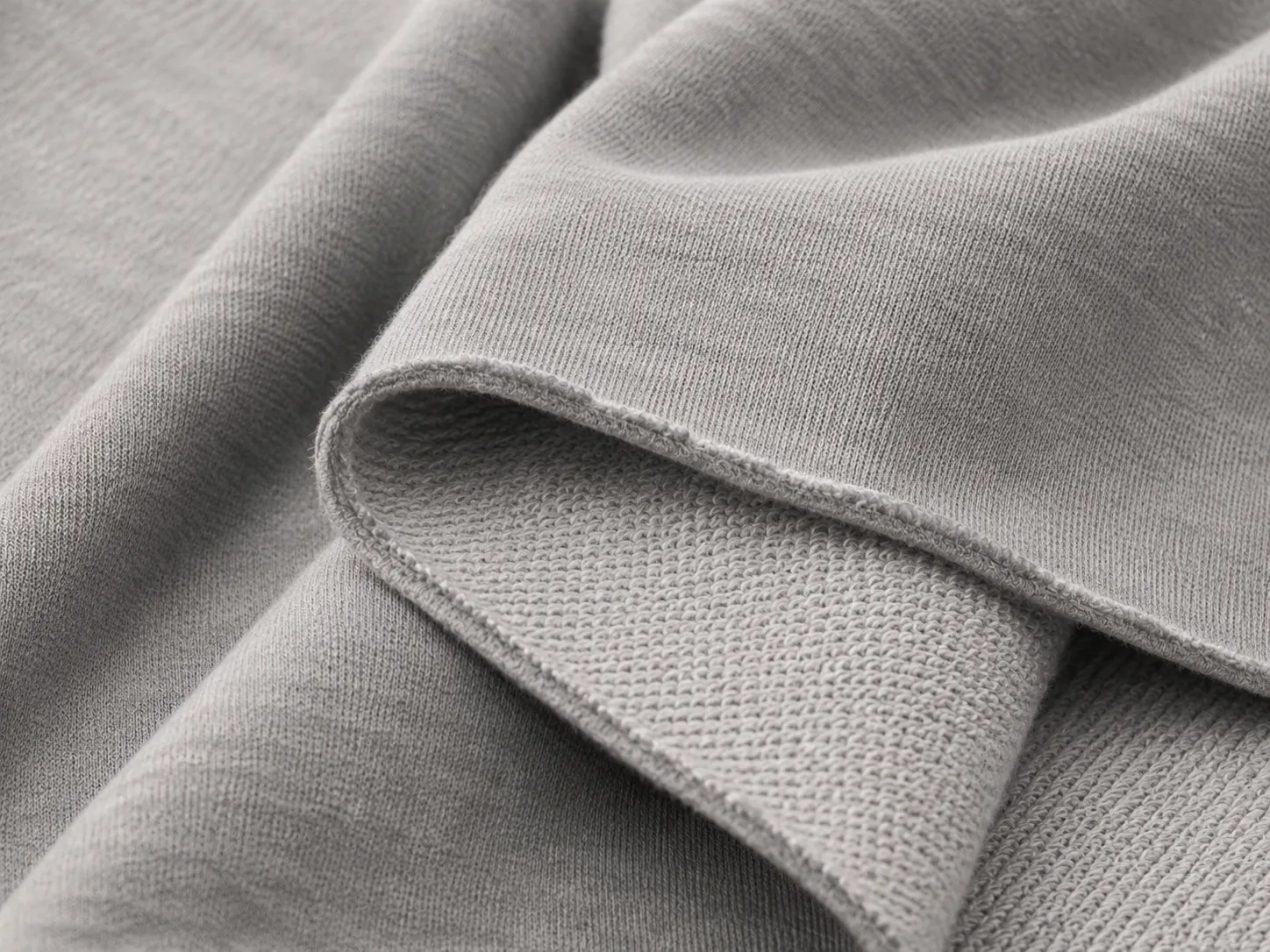
The name “two-thread” describes not the thickness of the fabric but the number of yarns fed into the knit: the ground yarn that forms the face and the binding yarn that leaves loops on the back. In the greige state these loops give a towel-like inner face; in this form the fabric is also known as french terry. If required, the inner face is lightly brushed to soften it. In the KARCEM catalogue, two-thread fleece is listed at cotton · polyester, 220–320 g/m².
What products is two-thread fleece used for?
Two-thread is the most versatile member of the sweat family: the looped inner face lets the fabric breathe, which suits transitional-season products, while the flat face offers a clean base for printing and embroidery. Typical uses are lightweight sweatshirts and hoodies, tracksuit tops and oversized “structured” cuts. For product-based selection, the sweatshirt and hoodie fabric page looks at weight together with fit and season.
Two-thread, three-thread and polar fleece side by side
The three fabrics overlap in weight but differ on the inner face, and the choice is made by the inner face:
| Fabric | Inner face | Composition | Weight | Typical use |
|---|---|---|---|---|
| Two-thread fleece | Looped or lightly brushed | Cotton · polyester | 220–320 g/m² | Sweatshirts, tops |
| Three-thread fleece (brushed) | Brushed, raised | Cotton · polyester | 280–420 g/m² | Sweats, joggers |
| Polar fleece | Raised, often on both faces | 100% polyester | 220–400 g/m² | Outerwear, linings |
For a breathable transitional-season product, choose two-thread; for a warm winter body fabric, brushed three-thread fleece; for an insulation layer or lining, polar fleece comes to the fore. To see the structural difference between two-thread and three-thread step by step, see the two-thread vs three-thread comparison.
What should a two-thread fleece specification include?
- Weight: target g/m², acceptance tolerance and whether it is measured on greige or finished fabric.
- Composition: the cotton–polyester ratio, and which yarn sits on the face and which on the inner face.
- Inner face: unbrushed loops (french terry) or light brushing.
- Yarn quality: combed, carded or open-end — it determines surface evenness and cost together.
- Colour and shrinkage: lab-dip approval and the accepted dimensional change tolerance.
- Cuffs and waistband: the need for rib matching the body.
Frequently asked questions
Can two-thread fleece be worn in winter?
With its unbrushed looped inner face, two-thread is primarily a transitional-season fabric. For a winter product, either the weight is pushed to the top end of the band or the inner face is brushed; if more warmth is needed, brushed three-thread fleece with its backing yarn is the right choice.
Are two-thread fleece and french terry the same thing?
In practice, usually yes: two-thread with an unbrushed looped inner face is sold on the market as french terry. However, “french terry” describes an inner face more than a knit structure; an unbrushed three-thread can also have a terry character. Specifying the number of yarns and the inner-face finish in the order, rather than the name, avoids confusion.
Does two-thread fleece pill?
An unbrushed looped inner face is less prone to pilling than a raised surface. On the face, the tendency is determined by yarn quality: combed yarn gives a smoother, more resistant surface than carded yarn. At batch acceptance, pilling and Martindale testing measures this.
Can two-thread fleece be printed?
Yes; its flat face is the most print-friendly base in the sweat family. Digital printing comes to the fore for low-volume, multi-colour designs and rotary printing for high-volume designs with few colours; the threshold is explained in the digital vs rotary printing comparison.
What determines the price of two-thread fleece?
Because two separate yarns are fed, the price starts with the type and count of both yarns; the quality of the yarn used on the inner face determines both the hand and the cost. Weight, whether the inner face is left unbrushed or brushed, the number of colours and the batch size are the other cost items; brushing adds to the cost as a separate finishing step.
With KARCEM
The problem buyers most often face with two-thread fleece is inner-face character and weight drifting from batch to batch. KARCEM knits the greige fabric on its own machines, measures weight on the greige fabric and plans dyeing and finishing to the same specification. You can see all sweat options in the knit fabric catalogue.
One contact, end to end: knitting on our own machines · dyeing, printing and finishing at supervised contract partners · lot quality control · ΔE<1 colour verification · certificates and TCs · sampling · shipment. See the production process →
Products made with this fabric: Hoodie & Sweatshirt Fabric
Certification and documents: Certifications · How to Verify a Textile Certificate